

Trail Relics, part 3 of 12. The moments that built snowmobiling, fact-checked against museum archives, manufacturer records, and 50 years of sled press.
Every garage has an unsanctioned project. The lift kit your wife voted against. The engine swap your buddy called a mistake. The machine you built anyway.
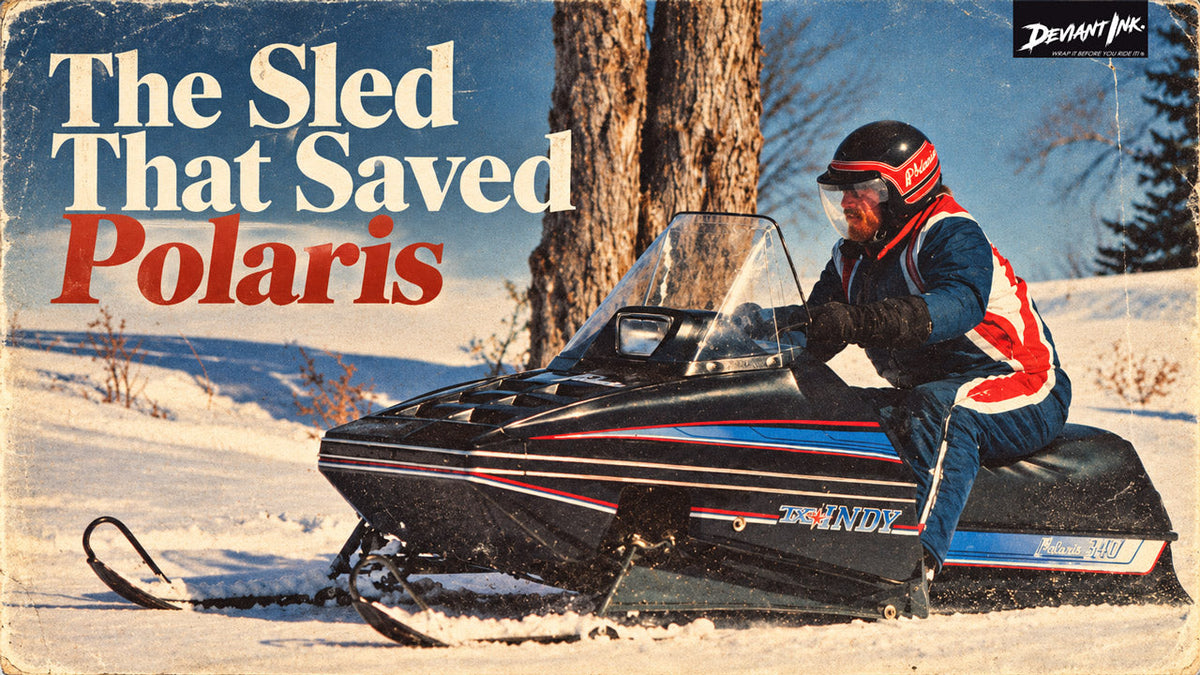
The biggest unsanctioned project in powersports history happened in a farm equipment shop in Roseau, Minnesota, and it became Polaris.
THE SHOP
In the early 1950s, Roseau was a farm town a few miles from the Canadian border, and Hetteen Hoist and Derrick was its machine shop. Edgar Hetteen ran the business with his younger brother Allan and their partner David Johnson, building and repairing farm equipment for the surrounding countryside.

Winters up there are long, and the crew had been kicking around the idea of a motorized machine that could cross snow. Edgar was not interested. Farm equipment paid the bills, winter toys did not, and he considered the whole idea a distraction from the real business.
Reasonable position. Wrong, but reasonable.
THE BUILD
In the winter of 1955-56, Edgar left town for a stretch (accounts differ on why, a sales trip in some tellings, a vacation in others, and it does not matter). That was the window.
David Johnson, with help around the shop, built the machine while the boss was gone: spare parts, welded steel, a grain silo conveyor belt in the drivetrain, and whatever else the shop had lying around. No product plan, no budget approval, no permission. Just a guy in northern Minnesota who wanted a machine that could ride on snow, building it with what he had.
It was crude. It was slow. It worked.

>>> TRY THE INDUSTRY'S #1 SNOWMOBILE WRAP CUSTOMIZER
THE $465 THAT ENDED THE ARGUMENT
Here is the detail that makes this story perfect: before the sled had a chance to become a fight, it became revenue.
Local lumberyard owner H.F. "Pete" Peterson saw the machine and bought it for $465. And the shop, at that exact moment, badly needed $465 to make payroll. Edgar came home to find that the distraction he never approved had just covered the paychecks.
The argument was over. Not because anyone won it, because the machine sold. By the end of 1956 the shop was building more, and the line had a name: the Sno-Traveler.

WHAT ROSEAU BECAME
That farm shop is now one of the biggest names in powersports, and here is the part that gets us: Polaris never left. Nearly seventy years later, Polaris snowmobiles are still built in Roseau, Minnesota, in the same town where David Johnson welded the first one behind his boss's back.
There are Fortune 500 companies with cleaner origin stories. There are none with a better one.

THE CRAZY PART
The first Polaris was not a product. It was a build.
Nobody commissioned it. Nobody approved it. One guy with shop access and a stubborn idea put it together out of spare parts, and the market did the arguing for him. Every rider who has ever wrenched on a machine against sensible advice, every unsanctioned garage project that turned out better than the sanctioned plan, is running the same play David Johnson ran in 1956.
The garage-build spirit is not a chapter in this sport's history. It is the whole book.
And for what it is worth, we take the Polaris part of this story personally.
Deviant Ink is one of only a few officially licensed Polaris graphics providers on the planet, which means when you build a custom wrap for your Polaris, it carries the real deal, approved designs on a machine whose entire family tree started with a guy ignoring his boss. David Johnson would have wrapped his sled. Nobody was going to tell him not to.
Share:
Trail Relic 2: The Typo That Named an Industry (1959)
Trail Relic 4: 1,200 Miles Across Alaska to Prove a Point