

Trail Relics, part 2 of 12. The moments that built snowmobiling, fact-checked against museum archives, manufacturer records, and 50 years of sled press.
Here is a fun question to settle at the next parking lot or trail head:
What do you call the machine you ride?
Because a huge chunk of snowmobile riders, especially up north and across Canada, do not say snowmobile. They say sled, or they say Ski-Doo, the way people say Kleenex or Crock-Pot. One brand name swallowed a whole category.
And that name was a mistake. Literally.
The workhorse years
Long before anybody snowmobiled for fun, Joseph-Armand Bombardier was building snow machines because people were dying without them.
Bombardier grew up in Valcourt, Quebec, and opened his own machine shop there in 1926. The problem he spent his life on was brutally simple: in rural Quebec, snow shut the roads down for months, and if you needed a doctor in February, you had a problem.
His answer, starting in the 1930s, was a line of big tracked utility machines, including the seven-passenger B7. These were work rigs, bought by country doctors, mail carriers, missionaries, and anyone else whose job did not stop for winter.
They were brilliant. They were also the opposite of fun. Nobody looked at a B7 and thought about carving a lake at sunset.
1959: the machine built for no good reason
By the late 1950s, Bombardier was chasing a different idea: something small, light, and affordable. One rider, one engine, one track. Not a machine that carried you through winter, a machine that made you want more of it.
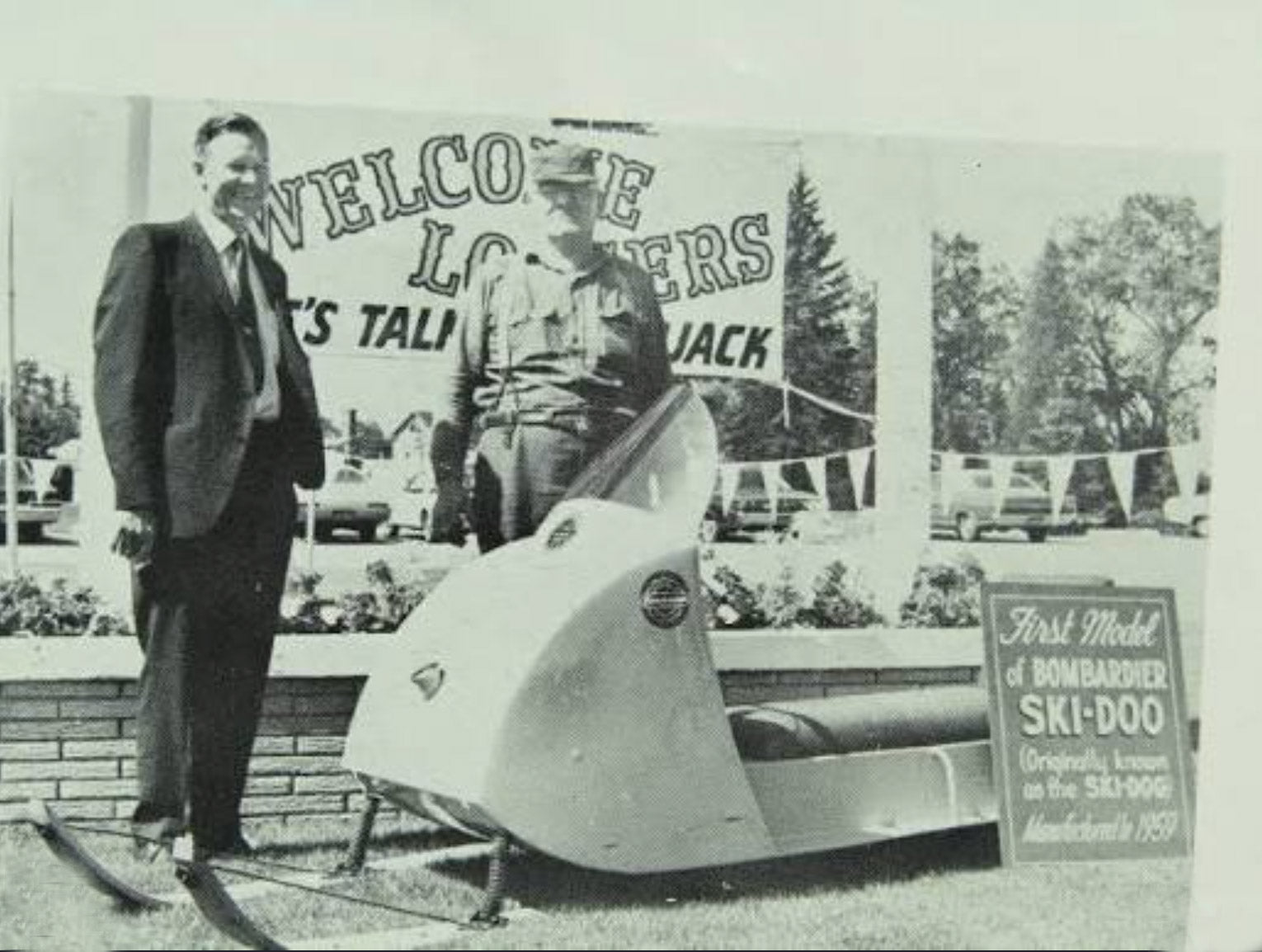
He finished it in 1959. Early that year he brought a working prototype to a missionary outpost in northern Ontario, and everyone who tried it lit up. He ended up donating the prototype to the mission, and he went home convinced the little machine was not just a tool. People wanted to ride it for the sake of riding it.
The name they settled on was Ski-Dog, a nod to the husky teams these machines would replace.
The mistake
Then the marketing materials came back from the printer.
Somewhere in production, Ski-Dog became Ski-Doo. One letter. The story, as the Bombardier Museum in Valcourt tells it to this day, is that Bombardier looked at the error and decided he liked it. It sounded better. It was distinctive. And unlike a common phrase, it could be trademarked cleanly.
So the typo shipped. The Ski-Doo went into production in late 1959 and sold 225 units its first year, the first mass-produced personal snowmobile, the first snow machine built for fun instead of survival.
Within a decade, the little accident of typesetting was outselling everything, and the name had gone generic: people rode Ski-Doos no matter whose logo was on the hood. Sixty-plus years later, plenty still do.

Why 1959 is the birth year
Machines that crossed snow existed before 1959. Carl Eliason was hand-building motor toboggans in Wisconsin back in 1924 (that whole story is in Relic 1), and Polaris was selling utility Sno-Travelers out of Roseau by the mid 50s.
But 1959 is the year the sport was born, because it is the year someone mass-produced a machine whose entire job was joy. Every trail network, every club, every race, every Saturday morning in the garage traces back to the decision that a snow machine could exist purely because riding one feels good.
The part we cannot stop thinking about
The most famous name in powersports was an accident somebody chose to keep.
Bombardier had every reason to fix the typo. Reprint the brochures, protect the plan, play it safe. Instead he looked at the mistake and saw something better than what he meant to do, and he committed to it.
Anyone who has ever built a custom sled knows that exact moment. The colorway you fat-fingered in the customizer at midnight and then stared at. The name placement you tried as a joke and could not unsee. Sometimes the accident is the identity.
The whole sport is named after one. Choose your mistakes carefully, and when a good one shows up, keep it.
Share:
Trail Relic 1: The Foot Problem That Started Everything (1924)
Trail Relic 3: Built While the Boss Was Out of Town (1956)