
Sledder Cast #003, part one, featuring backcountry snowmobiler Levi Green. We sit down with Levi at Hay Days and chat about his experience in the Marine Corps, transitioning out of the Marines and searching for an occupation that aligns with his snowmobiling passions.
Levi tells us all about the All American Heroes Foundation and his experience teaching the US military how to operate a snowmobile in areas with friction, including digging a road through a mile of drifted-in trail. We also take a stroll back in the history books and get schooled by the Samurai.
Guest
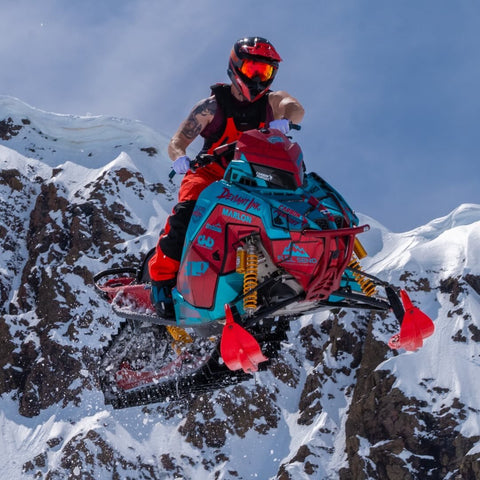
Levi Green
Levi grew up in Twin Falls, Idaho, riding sleds with his dad from age five, starting on a 1980s Ski-Doo Citation. Three days after graduating high school he left for Marine Corps boot camp, and he served four years in the infantry as a mortarman, deploying to Iraq twice. He spent about two full seasons guiding and wrenching for Caleb Kesterke's Proven Progression riding clinics. Today he sells insurance with Farm Bureau in Idaho and helped turn his club's Magic Valley grass drags into Tater Days.
Show notes
- 0:00Twin Falls, Kimberly, and a bridge you can legally BASE jump
- 5:49A first snowmobile at age five: a 1980 Ski-Doo Citation with metal skis
- 7:16Signing up for the Marine Corps at 17, boot camp three days after graduation
- 8:30Four years in the infantry as a mortarman, then a forward observer
- 10:05Two deployments to Iraq, then a lineman apprenticeship back home
- 11:48Leaving the utility in April 2023 to get deeper into the sled industry
- 12:42The sport that gets taken away every summer, and the Hay Days vibe
- 14:41What All American Heroes puts on for veterans
- 18:18Teaching US military units to ride and operate snowmobiles
- 20:31Jumping into open ice water in full snowmobile gear
- 22:18The Samurai lesson on preparing for the worst
- 27:26An eighth of a mile of road digging turns into a mile and an eighth
As soon as you hit the water you have to collect yourself, calm your breathing, and then calmly ask for permission to leave the water. If you hesitate, if your voice breaks, you have to do it again.
Win a free custom wrap
Drop your email and what you ride. We draw winners all season and announce them on the show.
Before battle, they would imagine themselves being ripped apart by arrows and swords, the absolute worst. So when they actually went into battle, they had already lived through it.
Questions answered in this episode
What branch of the military did Levi Green serve in?
The US Marine Corps. He signed up at 17, shipped to boot camp in San Diego three days after graduating high school, and served four years in the infantry as a mortarman and later a forward observer. He was based at Twentynine Palms, California, and deployed to Iraq twice. 7:16
What is All American Heroes?
In Levi's words, a group of veterans looking for purpose, started by Aaron McCarthy. It raises money year round to put on events for veterans: AIARE avalanche training taught by Tyler's Backcountry Awareness, rider skills, backcountry survival and first aid training, veterans rides and a snowmobile giveaway. Levi is an ambassador. 14:41
How did Levi Green help teach the US military to ride snowmobiles?
Through All American Heroes he got connected with Tyler's Backcountry Awareness, which has been helping some US military units build snowmobile training. Levi went out as an instructor to teach service members how to ride, operate and use snowmobiles effectively in a warfare setting, on Polaris RMK 800s and Titan 800s towing toboggans of gear. 17:43
What is a friction in snowmobile travel?
Anything that slows down your movement. Levi's examples: a powder field where everyone keeps getting stuck, a slide path covering the trail when you can't sidehill, or a big down tree across the trail. In the training they put those obstacles in front of the group and let them work through them as a team. 24:17
How do you dig a snowmobile road through a drifted-in trail?
First check the avalanche forecast and assess the slope before you dig. Then start just a little uphill from where you want the road and build it down to the slope, working with the terrain as much and as quickly as you can. Levi's group did it with regular snowmobile shovels for about a mile and an eighth. 26:27
It doesn't matter where you served, what you did. If you're a veteran, we have something in common and we can relate.
Full transcript32 minutes · 13 sections
Read it
Lightly edited for readability. Click any timestamp to jump the video to that moment.
0:00 Twin Falls, Kimberly and the Snake River Canyon
Okay, welcome back to another episode of the Sledder Cast podcast. We've got Levi Green here, coming to us all the way from Idaho, just like we are. He's just on the other side of the state. What's up, Twin Falls?
It's Kimberly, but we're pretty much right next to Twin Falls, so I always tell people Twin Falls. Everyone knows Twin Falls.
Right. Twin Falls, you've got the Niagara Falls of Idaho there, right?
Yeah. I can't remember the exact number, but it's about 50 feet taller than Niagara Falls.
There you go. I don't think most people even know that.
No. And we also have one of the only legal bridges to BASE jump from in North America, down in that canyon.
Really? In the same area?
Yeah. The main bridge, the Perrine Bridge, crossing over into Twin Falls from the interstate. You can legally BASE jump that.
Wow. You don't need a license or nothing? Didn't Evel Knievel do something there?
Yeah. Maybe his son, or was it him? I can't remember. I think it was his son, or it might have been him. I can't remember the story, to be honest. But there's a big jump that's still in place where an attempt to jump the canyon was made.
Just full send, an attempt at it.
Yeah. And now there's a walking path, so you can park in multiple locations and walk all along the canyon, and one of the sites to see is that jump.
Wow, so it's still there. Some historical stuff going on in Twin Falls. So if you're not familiar with Idaho, we're located in southeast Idaho, about an hour west of the Driggs and Teton area, and about an hour or so south of Yellowstone National Park. And Twin Falls is probably two and a half, three hours from where Deviant Ink's out of.
Yeah, two and a half. It's in between you guys and Boise.
Yep. Right in the middle there.
2:11 Riding zones and a Sawtooths backpacking trip
And so riding zones for you, you're going to go over that way, or you're going to go straight up into the unknown?
Yep. We can go straight up into the unknown, up the Sun Valley area. There's a few spots. We have a local area that's also Sawtooth National Forest, but we call it the South Hills, and there's actually sometimes pretty good snow up there. Some challenging terrain if you know where to go.
The Sawtooths are just beautiful. Super gnarly there. I've never been over there sledding. I've only been over there hiking and backpacking.
Yeah, if you get into backpacking over there, you're in for a treat.
Oh my gosh, yeah. You just got back from a trip, didn't you? Was that the Sawtooths?
Yep. I went up into an area, not going to disclose the place because it's pretty blown out as it is, but man, it was beautiful. Made a trip up there with Maddie, actually, and we did an overnight stay, and that was really cool. Just gorgeous. We got hailed on pretty good on the last quarter mile.
Oh, dang. But at least it was the last, not the first, right?
Yeah. It's always a bummer when you start things off that way. But man, it was an awesome trip.
3:39 Leveling up, and a first sled at age five
Well, cool, dude. So we're going to talk sledding, of course. We're going to talk about your story, your history in the sport, what you've done outside of snowmobiling, and a lot about increasing your skill set, leveling up on the snowmobile. As we've been working with you, you were obviously an awesome rider, snowmobile athlete, ambassador of snowmobiling when we first began. But dude, lately there's been a noticeable change in what you're now doing with a snowmobile and on a snowmobile.
And I think that's pretty relevant to a lot of us snowmobilers. We feel pretty good about where we're at with our skill set right now. Maybe we consider ourselves an intermediate backcountry rider. Okay, what if we want to take that next step up? What are some of those things we should be focusing on? I mean, you're a huge advocate for strength and conditioning, and you've had quite the transformation there as well.
So we're going to get right into the conversation, but let's kick things back. Let's talk vet, military background. Start us off there. What's your history, the time you served in the military, and how you went from that to snowmobiling?
Yeah. Well, shoot, I think I wasn't even one yet when my dad had me on a snowmobile. I was in diapers. I think there was a time when I was two years old he had me going up some hills on the front of the sled with him, and everyone in the parking lot thought he was crazy.
You probably would have made the news outlets today if stuff like that was going on, right?
Yeah, CPS might have been called if today's standards were in place. When I was five I got my first snowmobile. It was a 1980 Ski-Doo Citation, I think it was a 250, and it had metal skis and everything, and I thought it was the coolest thing in the world. I was like, I got my own snowmobile, just a five-year-old all fired up. And yeah, that kind of kick-started it for me.
So you started young. It's always nice to pass that on to the next generation, right? Build that fire.
Yeah, absolutely. I've got a three-year-old son, Clayton, and he's already ripping. He's coming with me this season. He went last season a couple times and we had some challenges to work through, but this season he's all fired up, and it's pretty much a daily thing that he's wanting to go ride. I put him on the sled to load it up onto the deck, and since then...
You've already got him trained to load it up on the sled deck. There we go.
Yeah. Oh man.
7:16 Joining the Marine Corps
Nice. So you started young in the sledding world, and then you've got some pretty cool military background, and you're still working with some groups associated there. You mind talking a little bit about that?
Yeah, I can talk a little bit about it. Shoot, I think at about 17, after my junior year of high school, I made the decision to join the US Marine Corps. I was pretty fascinated with the military from a young age. I had a great-grandfather that was in World War II in the Navy, and just from sitting down and watching old World War II documentaries and stuff, I kind of got the bug that I had a purpose to serve. I knew in my heart that's what I wanted to do.
So when I was 17 I signed up, and then I had a whole senior year of preparing to go off to Marine Corps boot camp. And three days after I graduated high school, I was on the yellow footprints down in San Diego getting screamed at.
No summer, bro?
No, I did not have a summer. I went from high school to the Marine Corps, getting yelled at while all my friends were out partying and taking a year off so they could figure out their life. And there I was, questioning my life decisions, like, what did I get into?
But no, I did four years in the Marine Corps. I went into the infantry and became a mortarman. Then through being a mortarman I got the opportunity to be a part of a sniper indoc for about nine months, and after those nine months I was like, yeah, I'm not going to get a school spot. So I went back to my mortar platoon and became a forward observer for them. And then I decided that I missed snowmobiling quite a bit. I loved it so much as a kid before going in the Marine Corps, and I loved the mountains and just being in the mountains, and I realized the desert just wasn't quite for me.
A little bit different landscape there. So you went in at 17, and then you clocked out at what, how old were you?
I signed up when I was 17, I went in when I was 18, and then about 22 is when I got out. I was based out of Twentynine Palms, California, which, I don't know if you know, it's just north of Palm Springs up in the desert, and that is one hot place. For months you're not really seeing temps below 100.
Oh gosh. Even night and day?
Yeah.
That's no good.
And then I did two deployments to Iraq. We did some stuff over there for Operation Inherent Resolve, and then came back.
10:20 After the Marines: lineman to the sled industry
Once I got out, I was kind of scrambling to figure out what I wanted to do in life, but I didn't really waste any time. I knew that one, I had to make enough money to snowmobile and support a family, and two, I needed to do something that was going to line up with life, something I was going to enjoy doing. So I landed on the career path of becoming a lineman, and I went to school for that right after I got back.
After school I wanted to get on with the local utility, so I did what every one of the other kids did and went out and contracted and built up that experience, so I had a resume that stacked up against the rest. Then I could put in and try to get on with the local utility, which I ended up doing. I got into their apprenticeship, and I did about three years of that before I decided that things in snowmobiling were getting pretty heavy, and the career path I was on was not going to line up with where I wanted to go in life.
And you were still doing that a year ago, weren't you? A year and a half?
Yeah, up until I left the utility. Shoot, I think it was March or April of '23.
April of this year. There we go.
Yep. Over the last couple years, when I left the Marine Corps, I picked up a snowmobile and got back into the sport, and fell more and more in love with it each season. And as I fell more in love with it, I just wanted to get involved in the industry. And the more people I met, the more I learned what this industry offers, and it's incredible. You look at the people you meet, like yourself. My relationship with you and several other people in the industry is just absolutely incredible.
Likewise, appreciate it.
12:42 When snowmobiling gets taken away, and the Hay Days vibe
Well, and we've had this conversation. If you want to call it a hobby, or just what you're into, there's not very many like snowmobiling where it gets taken away from you. Golf, for the most part, if you want to do things like that you can go somewhere and do it year round, go on vacation and do it. I guess if you want to go to Chile or somewhere you could maybe consider that, but it's a little more difficult to pull something like that off. As snowmobilers, we get that ripped from us. And for some it could be a nice reset, to refocus on some other things. But by the time it comes back, you can just feel it here at Hay Days.
Oh yeah. Yesterday was bonkers.
The vibes are at an all-time high right now. Everyone's getting fired up, getting ready for the season, even if they only ride one month of the year. They get their four trips out west, whatever that is, and it's on. I'm thinking 95% of the people who are here believe it's going to be snowing next week. That's the kind of vibe.
The amount of snow dances I've seen, I swear.
Yeah, it's been great. Just comparing to last year, we're right across from KLIM. If you're out here you'll notice they changed things up quite a bit, opened things up massively. Super cool setup they have. But this area that we're in right here has been awesome. Just super bonkers yesterday. The vibe is high and the stoke is high.
14:20 All American Heroes
Oh yeah. We had some conversations yesterday with All American Heroes. We've worked with them in the past, the last couple years, on some things. And I don't know what your role is.
I'm an ambassador for them.
Maybe just give us a quick rundown of who All American Heroes are and what their mission is.
Yeah. All American Heroes is really just a group of veterans that were searching for purpose in life. Aaron McCarthy really started that up, and he's who got me into it, so I have to give a shout-out to him, because he's definitely changed a big aspect of my life when it comes to the experiences that have come through All American Heroes.
One of the things they do is raise money year round, and they work with different companies to try and put together these events. Whether it be avalanche training, like AIARE-certified avalanche training, which Tyler's Backcountry Awareness has been teaching. Rider skills training. Backcountry survival training and first aid training. And then just veterans rides, to get veterans that are in the industry and want to link up with other veterans together. Because we have this mindset and this wired connection that, I mean, you could talk to a civilian all day long about it, but they're not going to understand.
They haven't been put in the types of situations that you guys have all been in.
Exactly. And so there's that common brotherhood. It doesn't matter where you served, what you did. If you're a veteran, we have something in common and we can relate, and we're going to have that brother and sister bond almost right away.
Which is so cool, especially nowadays, because bonding with other humans is few and far between. That's how society is, right? So having that connection is awesome.
16:43 Teaching the military to ride
And I remember you telling me, I think it was at the Idaho snowmobile show in Boise with SnoWest, about this snowmobiling event that you were going on, out in the wild with a bunch of vets. Was that with All American Heroes, or was that completely separate?
That was an opportunity that actually came through All American Heroes.
Okay, so it came through them. So you guys got together and headed out into the backcountry, and you're doing stuff out there. What kinds of things did you guys do? All vets? Were they fresh to snowmobiling, or were they all somewhat experienced?
So All American Heroes is the vet side of things. That's where they raise money to do all these things, and they also do a snowmobile giveaway, which is really freaking cool. Tyler's Backcountry Awareness provides avalanche training as well as other training, and they've been working with some units in the United States military to help build snowmobile training in those units. Through All American Heroes I got associated with them...
Affiliated.
Yeah, affiliated. And the opportunity came into play to go out and help teach some of the US military how to ride and operate snowmobiles and use them effectively in a warfare setting.
So gnarly, bro.
It is. And so I'm very grateful for that opportunity.
18:43 Jumping into open ice water
Some of the stuff that you did. You jumped in, like, you chiseled out a lake or something and then jumped into it, right?
Yeah.
With all your gear on and everything. Did I see a video? I'm not just making that up?
No.
You got your ice bath in the morning.
Yes. So we actually got done with a big ride. We were scoping out terrain for some of the training we were going to put on for the guys. We got done with that, and then Brian Lunstead, he's the guy putting everything together, looks at me and two other instructors, Ryan Chalupsky and Kyle West, and he's like, hey, you guys want to go jump in open ice water on a lake? And we're like, yeah, of course, why wouldn't we?
Most people would be like, heck no, you're freaking crazy. For us it was a challenge, something we wanted to see. And that's very common with vets, and people that are pushing themselves to see what they're capable of and how they can handle pressure. So that's what it was for us.
So we snowmobiled out to a lake, and one of the guys, he's actually Swedish Special Forces and does a whole bunch of training, cut a big old square hole in the ice, tied a rope to us, and we wore our snowmobile gear. And he's like, all right, jump in. So we jump in, and as soon as you hit the water you have to collect yourself, calm your breathing, and then calmly ask for permission to leave the water.
Calmly ask.
Calmly. If you hesitate, if your voice breaks, you have to do it again.
Oh my goodness. So was everyone pretty cool, calm and collected, or was there some initial shock? I've never done it in a full snowmobile suit. The water's frozen, so you're probably hovering around 30 degrees, maybe a little less?
Well, it wasn't all the way solid, obviously.
I bet you're in the ballpark of 32, 33.
Yeah. Cold.
So how many attempts did it take you to get in there and ask for permission to leave?
Actually, for myself, I don't know if it was that I had just mentally prepared and expected the worst. When I had already expected the worst and I jumped in there, it was actually less than what I expected. So it was easy to calmly collect myself and pull it together.
Expect and plan for the worst, and if it's not that, it's always going to be a better situation.
Exactly.
22:01 The Samurai lesson
Which, actually, I'd like to share this. One thing a gentleman taught me a while ago, when I was learning how to prepare for interviews for jobs. He read a book, and it was talking about Samurai. One thing the Samurai would do is, before battle, they would meditate, and they would imagine themselves being ripped apart by arrows and swords, the absolute worst. So when they actually went into battle, they were already mentally prepared for the worst. They had already lived through it. And that's why they were so good and so lethal.
Geez, that's powerful.
So you prepare yourself for a situation. It's not that you think of the worst and let that terrify you. You think of the worst as a preparation.
Okay, yeah. You're still going into it with optimism, that you're going to conquer. But you've already been there and done that before. So if you're headed that way, it's nothing new. You're not on a new path.
Exactly. If you can visualize the worst, and then go into the situation understanding that nothing's going to be worse than that, I mean, it could potentially, but it will help you a lot in situations where you're nervous.
That's cool. That's a good life lesson. Love it.
Yeah, it's helped me a lot.
23:38 Frictions on the trail
So you were telling me before we hopped on here that you taught the group how to build a road if you're in a pretty dire situation. Whether the terrain is too steep, or some part of your group isn't on the right snowmobile, and you've got to get through maybe a switchback or a corner or a bend. And you guys did that.
Yes. So one of the things on the lesson plan for teaching was how to navigate frictions. A friction is anything that can slow down your movement. That could be going through a field of powder where you're getting stuck everywhere. That could be going down the trail and all of a sudden you come across a slide path and the road's covered, and if you can't sidehill, that's a major friction. And it could be coming across a big down tree, which is one of the frictions we brought into place: a trail with a big down tree. So in some of our movements we put that obstacle in front of them and let them team build and work through those real-life frictions they could encounter.
The road building was really cool. We'd actually scouted out this area the weekend before, and it was good to go. There was a small section, probably about an eighth of a mile, where the trail went super steep and it was all blown in, and they'd have to dig out a road. Because these guys are on Polaris RMK 800s, and they also have Polaris Titan 800s towing toboggans that are full of up to 1,500 pounds of gear.
So that's going to present a problem for you, coming across something like that on a Titan pulling weight.
Yeah. If you don't know what a Titan is, look it up. It's a big machine.
26:01 Digging a road through a mile of drifted trail
So we scouted that out, and it was just a small section. Well, the day of the movement we get up to it, and there was a small snowstorm and a windstorm that followed it. First of all, if you are to attempt a situation like this, always look at the avalanche danger for the day. Understand the forecast, understand the hazards out there and the signs to look for. I can't stress that enough.
Absolutely.
We got up to the section of trail where we had planned this, and we assessed the avalanche danger before we attempted to dig this road. Through our assessments and multiple tests, we decided it was okay to proceed. So we proceeded with caution at first, and once everything looked good, we continued on at full speed.
Well, we got to the other side of our planned dig area, and when we got around this bend and connected the trail, we realized that windstorm and snowstorm had shut down almost another mile of trail.
Oh, goodness.
So it went from an eighth of a mile to about a mile and an eighth.
Wow.
And we were like, well, we weren't planning this, so we can turn around and go back. And these guys, military being so hard-headed, they saw the challenge and they're like, no, we're going to do this. We're going to push through. And we felt bad as instructors, because that's way more digging than we planned.
So digging, I mean, do they have tools, or just snowmobile shovels on their backs?
Just shovels.
Just shovels. Same as you would have in a normal outdoor snowmobiling situation.
Exactly. And the best way to do it is to start uphill just a tad from where you want your road and build it down to a slope, down to where you want to be. You're basically working with the terrain as much and as quickly as you can.
So you guys just did this for a mile.
Yes. If that's your only way out, man, you're doing it, right? That's the only way. And that was really cool to see those guys come together. They were willing to take on a challenge, and it was unexpected on both ends, for the instructors and for them. It's amazing what people can do together when they put their minds to it.
Yep. And they've already done it now, right? So if that ever comes up again in a real-life scenario, and sometimes those types of things don't have to be that dramatic, but if you've already done that little thing before, you're not panicking. You don't have to think much.
Yeah. If you have to do that again in real life, you go into autopilot and you start doing what you know.
And a group is always grateful for that guy in the group. That guy can calm 12 guys in a group.
Yes.
If you've got one levelheaded guy that can think through a situation, versus losing his mind.
Yeah, absolutely.
29:45 Wrapping up part one
Awesome. So let's transition. Okay, we might do two parts.
That works.
Because this was good stuff here. And then we can do a part two getting more into the backcountry skill building, which will be awesome.
Yeah.