
Sledder Cast #003, part two, with backcountry snowmobiler Levi Green. We sit down with Levi at Hay Days and transition into more snowmobiling topics.
We discuss what it takes to level up your snowmobiling skills, what it's like riding with and watching professional backcountry snowmobilers like Caleb Kesterke and Kyle Saxton and learning from them, how to get your body and mind right to maximize the days you spend on a snowmobile each season, and much more.
Guest
Levi Green
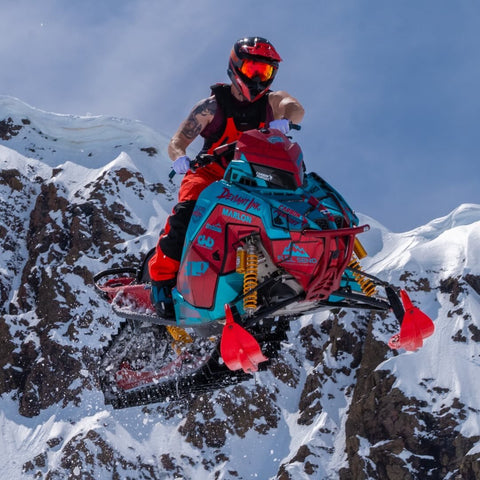
Levi grew up in Twin Falls, Idaho, riding sleds with his dad from age five, starting on a 1980s Ski-Doo Citation. Three days after graduating high school he left for Marine Corps boot camp, and he served four years in the infantry as a mortarman, deploying to Iraq twice. He spent about two full seasons guiding and wrenching for Caleb Kesterke's Proven Progression riding clinics. Today he sells insurance with Farm Bureau in Idaho and helped turn his club's Magic Valley grass drags into Tater Days.
Show notes
- 1:01Levi gets humbled riding outside his usual group and books a Proven Progression clinic
- 4:30Why you only see about 3% of a pro's riding on camera
- 5:11Look at the tree and you hit the tree: taking your focus off what could break
- 7:02Getting gassed after one hop over attempt, and why that sent him to the gym
- 9:07Kyle Saxton's take on flexibility and mobility
- 10:19Tagging along with Caleb to build jumps in Cooke City, spring 2021
- 14:24Caleb will hit a jump 20 more times to land in the exact spot
- 16:47No plan B, and why worrying about what could go wrong holds riders back
- 19:13Mistake one: thinking you need more power to learn technical riding
- 22:39A season on a 146 '22 Matryx Khaos with an Ice Age skid
- 24:24Mistake two: treating a dealership avalanche awareness class as training
- 27:20Three mods for a 9R 146: track, bars with a finger throttle, suspension
If you're always focused on what could break, what I could hit, what could go wrong, you're going to be too focused on the wrong things to actually push yourself, progress and learn.
Win a free custom wrap
Drop your email and what you ride. We draw winners all season and announce them on the show.
I can put in more reps, and more reps equals more learning, more experience, and that'll help you dial in your craft.
Questions answered in this episode
How do you go from an intermediate to an advanced snowmobiler?
Levi Green's levers: ride outside your usual group so you see where you really stand, take a clinic like Proven Progression, accept that mistakes and rolled sleds are part of learning, and keep your focus on what could go right instead of what could break. He also trains in the gym so he can get more reps in each day. 1:01
Why does fitness matter for backcountry snowmobiling?
Levi found he was gassed after a single hop over or bow tie attempt and had to rest five minutes between tries. Getting fit let him put in more reps per day, and more reps means faster learning. He adds that flexibility and mobility work cuts down on injuries and helps you recover. 6:07
Do you need a turbo sled to learn technical tree riding?
Levi says no. A turbo adds a lot of power and makes throttle control harder when you're learning hop overs, bow ties and edge control in tight trees. He went back to a naturally aspirated 850 to learn the basics, and suggests putting money into suspension and sled setup, and a shorter track like a 146, before power. 19:13
Is a dealership avalanche awareness class enough avalanche training?
In Levi's view, no. He says dealer awareness classes give you just enough to be dangerous and don't go into the detail of a formal Level 1, Level 2 or pro course. He also warns against trusting a slope because you've never seen it slide: the right slope angle, snowpack and a trigger can change that. 24:24
What three mods would Levi Green make to a Polaris 9R 146?
First, a stiffer track for technical riding, jumps and spring riding. Second, bars set up for his stance, paired with a finger throttle that took the strain off his left shoulder when side hilling. Third, suspension: at least a refresh of the stock shocks after the first season, or aftermarket shocks tuned to how he rides. 27:20
If you're trying to use power to compensate for your physical ability, then I would say you're holding yourself back a lot.
Full transcript38 minutes · 12 sections
Read it
Lightly edited for readability. Click any timestamp to jump the video to that moment.
0:00 Part two, and the physical progression
Okay, so we were going to do just one episode, but Levi dropped some bombs for us. Some goodies, some golden nuggets, all before we even got into the snowmobiling stuff.
Yeah, right.
So we may lump this into one, or maybe you're listening to part two right now with Levi Green. But we're going to transition more into the snowmobiling side of things. One thing that I mentioned kind of in the intro is just watching your progression. Physical progression. Talk to me about that. So you hit the gym, you hit the gym hard. You've cut a lot of weight, but got big.
Yes.
So what have been some of the levers there, or the mindset shift? Are you just doing overall body, or are you doing these things specifically for the time spent on a snowmobile?
1:01 Humbled, then a Proven Progression clinic
Well, I'll start off with kind of the beginning. A lot of years I only rode with a set group of people. Like most people, right? Most people have their group and they stick to that group and they ride with them, and there's nothing wrong with that. For myself, that's what I was doing, and I was starting to get pretty hungry. I was wanting to push myself. And it was pretty easy to assume that I was a good rider, because I was starting to become maybe the better rider out of my group.
And then I got humbled pretty quickly when I started expanding my riding with people that are elsewhere. I started networking, and once I started networking and riding with other riders, I quickly learned that I was not the rider that I thought I was.
You were once the big fish.
Yes. I was in a small pond, and it just flipped on me just like that. I was humbled very quickly. And in that same year, Caleb Kesterke started up Proven Progression clinics. I'd been watching his stuff on 509 and the videos he'd been putting out, and I was like, man, that dude's getting it. So I was pretty enticed to put together some funding and go out and see if my riding could even stack up.
So you went out as a customer?
Yeah, I went out as a client. I got a couple friends together and we made a trip of it, and I tell you what, I was blown away. Everyone was fired up, because everyone wanted to learn. When you go to a clinic like that and you're looking at learning some advanced skills or pushing yourself, generally the mindset of the group is very similar. Everyone's wanting to learn those things. So the stoke environment was incredible.
And then we also had Caleb, and Kyle Saxton was actually helping out at the time, and to watch those two ride, some professional level riders, it absolutely blew our mind. In videos you see it, but seeing that stuff in person and seeing what's possible on a snowmobile, it's like, holy crap. It opens up your eyes. And for me, I was hungry already, and then I was like, wow.
You were at the dinner table.
Yeah. I did not realize how hungry I was. Dude, that lit a fire under my butt.
4:00 What the highlight reels don't show
Well, but you also get to see the rest of it. A lot of times we just see the highlights. You don't really get to see the attempts that got you to the highlight, right? And you probably learn the most through being able to see those attempts that got the highlight.
Right. Well, a lot of it is, when those guys ride, yeah, there's some mistakes here and there that you don't really see on camera. But you're only seeing maybe 3% of the riding going on. And so when you watch and you see the fluidity, the capability, there's only maybe a handful of mistakes throughout the day where a person leaves the sled and the sled goes rolling.
But you also can't be afraid of that. You can't be afraid of the sled rolling or making a mistake. And that's one of the levers, opening up my mind to the idea that it's okay to make a mistake. You can't get frustrated every single time. For example, one of the things that's always preached is if you look at the tree, your focus is going to take you to that tree and you're going to hit it.
So if you're always focused on what could break, what I could hit, what could go wrong, you're going to be too focused on the wrong things to actually push yourself, progress and learn. So shifting that focus to, okay, if something breaks, I'll replace it or I'll fix it, and perform the maintenance I should be doing so that I can keep riding.
Yeah. And Levi is talking about levers because I hit him up and I'm like, dude, give me the two, three, four levers that took you from, whether we want to call it intermediate, to advanced. That ladder, that step up. And so he's dropping some of those levers for us. Love the “what you focus on is where you're going to go.” And that's true with anything, right?
6:07 Why fitness means more reps
But kind of back to the fitness aspect. After doing that clinic, I realized that in the career path I was on, I had a very limited time to take advantage of the snow season. Most professional athletes out there that are very, very talented, they earned that talent. It wasn't just given to them. It wasn't like they woke up one day and they were Caleb Kesterke, Brett Turcotte, Kyle Saxton, Chris Burandt. They earned it, and they put in the time, the money, the hard work, the blood, sweat and tears.
And so I was trying to figure out how I could balance my career with pushing myself in the sport, and one of those things was maximizing each day on the snow. I was like, okay, well, I'm getting burned out after one hop over attempt or one bow tie attempt, and then I've got to sit for five minutes, catch a breather and then go do another attempt. That ain't going to work, because I can only get a handful of reps in.
So I started pushing my fitness and really focusing on my body and being intuitive there, so that when I go out and ride I can maximize each day. I can put in more reps, and more reps equals more learning, more experience, and that'll help you dial in your craft. So that's how fitness ties in for me.
And you see a lot of these guys who are really pushing it, there's a physical side of it. There's a transformation. I remember watching, I don't know if it was posts or videos, the transformation of Caleb. He didn't always look the way he looks. Dude's jacked now.
Oh yeah. You look at Kyle Saxton too. Kyle went through a big transformation as well.
I think you just get to that point where it's like, I can only do so much with the body that I'm in right now, and if I want to take that next step, I've got to make some changes.
Yeah. Well, I'm a big advocate for it, because if you take care of your body and you prepare it for what you're about to put it through, you're going to recover better, you're going to have a better time on the snow, you're going to enjoy the sport more. And if you work on flexibility and mobility, you're going to have less injuries.
Which is one of the biggest. Injury, and you're down.
Yeah, because for so many people, flexibility and mobility is one of the biggest things that gets thrown out the window. Kyle Saxton actually told me one day when we were working out in the gym, he was explaining what he does for stretching, and he's like, it's how far your head can go behind your back before you break.
Okay.
And I don't know if you've seen some of his impacts. It's like, how are you okay after that?
Yeah, some of that stuff where he's just coming around the corner in the air and it's just like, boom.
Yeah, exactly.
9:48 From client to tail guide
Okay, so the physicality side of it, on point. But you started spending some more time with Proven Progression, and this last season you got some paces up there with those guys, with Caleb. Walk us through, from your experience thus far, what a day looks like with Proven Progression in a clinic up there. If someone's interested, what can they expect?
Absolutely. My start with Proven Progression, obviously, I was a client. And then kind of late spring of 2021, I believe it was, all my friends had hung up their sleds for the season and called it quits, and I couldn't find anybody to ride. So I reached out to Caleb and I'm like, look, I'm not the best rider, but if you're still riding, do you mind if I tag along, or do you want to go ride? I was trying to invite him out, because I just wanted to get on the snow, really.
And it just so happened they had a group headed out to Cooke City, and they were going out to build jumps. I'm like, sweet, never done it before. I've hit natural jumps, and I think I shoveled a cornice out one time to jump. Other than that I didn't have any experience. So I went out there, and that was my first experience with jumping, and it was a lot of fun.
After that I networked and talked a little bit more with Caleb, and the opportunity came two seasons ago to come out to his jump clinic and help build jumps, and work as a tail guide. I wasn't getting paid or nothing. I just wanted to come out and help and experience it, and maybe see what I had to offer people. Through that I found that I loved teaching snowmobiling. Sleds are so much fun as it is, the machines are very capable, and if I can help one person enjoy the sport that much more, that's incredible.
Seeing someone's face light up when they've done something for the first time, or they hold an edge longer than before my interaction with them, or they do their first bow tie or hop over or whatever it may be. Just seeing their face light up, and they're just so excited, that's worth everything. That's so fulfilling. You can't beat that with a stick.
Yeah. And to be in that space in the industry and do what you guys do, you have to have that.
Yeah. Otherwise you're going to be more focused on yourself rather than someone else. Which, not everyone has to go that direction.
No, but the good ones have that sort of compassion and that desire to see the progression, not just in themselves, but in others.
Yes. And that's what's really cool about working with Caleb. Last year I jumped in on two other clinics, an intermediate and a beginner clinic. He was short, so I jumped in and helped out, and I really enjoyed that. What's cool is he is just as driven about helping people, because he loves the sport so much. He's doing it because he wants to help people enjoy the sport. That's why he does what he does. He's that passionate about it, and to see that side of someone doing what he's doing in the industry is really cool.
Yeah, and there's not many people that are willing to do that.
13:49 What Caleb does differently
And you mentioned some things that guys like Caleb do differently. We talked about the physical side of things, but as you've sat back and kind of analyzed the process with Caleb, what are some things you've noticed where, man, he just does things differently, and that's made all the difference?
He's not really willing to call it quits. A lot of people, when something gets difficult or hard or they're frustrated, they call it quits. When he gets frustrated, for example, let's say a jump didn't turn out quite the way he wanted. Maybe he didn't land in the exact spot that he wanted to. He will probably hit that thing another 20 times, and blow the landing out, whatever, reshape the jump to hit that spot.
Wow.
The level of drive that he has to perfect what it is he's trying to achieve. If there's something he wants to perfect or to nail, he almost can't sleep at night if he doesn't get it exactly how he wanted.
As you were saying that, I was like, why is that unique? Because if you were to tell me that's how LeBron James or some professional athlete handles their business, I would say, well, duh. That's why they're a professional athlete. It's the same thing, it's just a different sport. Of course the guys are doing those types of things, because they are professionals in their sport.
Yeah, it's because they want it. You have to want it. And that's kind of where I'm at. I've always been passionate about snowmobiling, and I've always looked up to the professionals in the movies as a kid. I burned out a 509 Volume 7 DVD because I watched it so many times. I fell asleep going to bed at night to it so many times that I had to go buy another disc so I could keep watching it.
That's funny.
So now that I see there's an opportunity out there to achieve this childhood dream, you go all in for it. When you see that it's an option and you can attain it, then why not?
16:47 No plan B
And a lot of people that are where they are have a plan A, and they don't even have a plan B. Plan B, you throw that out the window, because if you have a plan B, then you're not going to be focused on plan A. You're going to be willing to hold back a little bit. You're going to be willing to not put everything into plan A. And a lot of people do that. A lot of people are afraid to take this step because they're like, oh, what if. It's important to make educated decisions and to look at what could go wrong, but you have to look at what could go right if you actually go through with these things.
And it kind of comes back to the focus thing. If you're always focused on what could go wrong and you're focused on your plan B, you'll never achieve plan A, because you weren't focused on it. You were too worried about what could go wrong. And I'd say that's one of the biggest levers for pushing and progressing in the sport. People are too worried about what's going to go wrong. If you start focusing on what could go right and what you want to achieve, you'll achieve things you never thought you could.
Yeah, the mind's a powerful thing. And an organized mind that has some fire in there.
For sure. Absolutely.
So, a couple things before we wrap... before we wrap up.
I see what you did there.
Hey, I use that line every time. Just kidding. I don't know, it just flowed. Oh, my dad jokes are coming out.
Yeah, they are. I'm going to have to watch myself around you.
18:48 Mistake one: thinking you need more power
So we talked about a lot of good things that pros are doing that set them apart. But what are some of the mistakes we make in the backcountry that are pretty easily fixable? Just a few of those common things, a little tweak here, a little tweak there.
I would say the biggest that I have seen is people thinking they need more power.
Need more power.
Yeah. People thinking that they need more power to achieve what they're trying to achieve. If you're trying to use power to compensate for your physical ability, then I would say you're holding yourself back a lot. You can learn the basics, learn these maneuvers you're trying to achieve, and learn how to ride a sled that maybe doesn't have a turbo. And if you set up the suspension in your sled for the style of riding you're looking to achieve, you'll do so much better.
I see a lot of people that are wanting to learn bow ties and hop overs, or even just basic edge control, but they love the wheelie factor when they squeeze the throttle and that turbo comes on, on an open hillside. They want both, and that's kind of tough, because a turbo brings a lot more power into the equation and a lot more throttle control when you're trying to learn that tight technical tree riding, the hop overs and bow ties. It's a lot more to handle, and that sled's going to ride you.
Yep.
Now, if your goal is you just want to play out in the open, have a good time and climb some steep hills fast and whatnot, then it's a great option. But I do see a lot of people that want to get into that tight technical riding starting off with a boosted sled, and it holds them back a lot. And I had to learn that. When I jumped on my first turbo sled I was like, no, this is too much. I need to go back and learn how to ride a naturally aspirated 850.
And I tell you what, that was a great decision, because I learned the basics of hop overs and bow ties on those sleds, and now on a boosted sled I can do it in different locations, locations I couldn't get to with that naturally aspirated sled. So for learning, it's better to go with suspension and sled setup versus power.
Yeah. And so many people make such a fuss. Man, like the 600 Catalyst. Dude, we have a few 650s, just the Polaris 650s, and they ripped. When we would have 650 days, those were some of the greatest days last year, on those 650s. Different riding, but still fun as heck. It's not a boring day, and for the most part you can go and do almost everything. You just maybe don't go up to the top, right?
Yeah, absolutely. Or maybe it takes you a handful of extra attempts to get up there. Another thing: last year I had some issues with my Boost 155, so I rode my 146 a majority of the season, and I tell you what, that is a capable setup. I had a '22 Matryx Khaos, and I threw an Ice Age skid under there, did a 146 setup on it, and I loved it. Even in the deep powder. It was a challenge. You had to ride it fast, and you always had to be on it in the deep stuff. There was like two feet of fresh one time, and she was chugging along with the turbos, just giving that 146 all she had.
But that is a very capable setup, and it's a lot easier to learn these things on, versus someone trying to learn hop overs and bow ties and all this technical riding on a 165. It's just not really the ideal setup. So a lot of people get caught up in the big track and the turbo for mountains. If you want to learn the technical stuff, keep that in mind.
23:56 Mistake two: counting a dealer class as avalanche training
Okay, so don't focus so much on the power, don't be so fixated on it. Is there another common mistake you see out there on the mountain, or mindset?
Yeah, I would say one of the biggest mistakes I see, and it kind of hits home because my area over in Twin Falls is really bad for it, is a lot of people get this idea that because they showed up to a dealership avalanche awareness class, they know what they're talking about now. They've been through a class. And it's a little different than if you're talking about a formal Level 1 or Level 2 course, or the pro classes. Those awareness classes dabble in information and give you just enough to be dangerous, but they don't actually go through everything in detail and prepare you for what's going on out there.
And a lot of people also rely on, well, I've never seen it slide there, so it's going to be okay. Well, I can tell you that if you have the right slope angle, the right snowpack and a trigger, that could be a different story.
It doesn't matter if you've never seen it slide.
Yep.
Okay. Love it. That one's so common.
For sure. And a lot of people want to go push and do pretty wicked stuff on sleds, but they're not willing to sacrifice a little bit of time or a weekend to get some avalanche training. It is a sacrifice. You might have to take a little time off work, you're going to be out a little bit of pocket change, maybe that's a sled can for you or whatever it may be. But man, that avalanche training and knowing what you're dealing with out in the backcountry really helps you make better decisions.
Now, we all make mistakes. No one's immune.
And the mountain doesn't give a crap how much training you've had.
It doesn't, right. Even an expert makes mistakes out in avalanche terrain. But understanding those things helps you mitigate your risk and your exposure, and make better decisions for your group.
26:26 Lightning round: three mods for a 9R 146
Cool. So we're going to go to the lightning round. Couple questions here.
Oh boy.
You ready for this? We'll make them easy for you. I'll try to make them shorter.
Okay, now we're good.
So you got a fresh sled. She's naked, ready to do whatever you want as far as mods go, but you only get three. Oh, and a wrap doesn't count. What are the three? Let's go in sequential order, so number one, number two, number three.
Okay, which sled? What type of riding? Because I would pick different things for different makes.
Okay, so let's see. You're going to be on a 9R. Let's go your 9R.
9R. By the way, I've got a 9R 146 coming.
Okay, so we're talking 9R 146 right now.
Yep. First thing I would do is change the track. They're pretty soft, which is better for deeper powder and stuff like that, but for doing any sort of technical riding, bow ties, hop overs, jumps and spring riding, it's just too flimsy of a track.
Second would be bars. I think it's important to set your cockpit up to your riding and get you in the correct stance and the correct position to attack the trail. And with the bar setup, I'm going to tie this into one: I've become really fond of the finger throttle. Being able to add pressure to the bars with your right hand and control the throttle more has relieved pressure off my left shoulder, if you're doing a lot of side hilling.
Yeah.
If you're doing a lot of side hilling on your right side, then your left shoulder is doing a lot of work, and I noticed it would just start getting tired. I was always stretching it out. It kind of became my problem shoulder, and I didn't understand why. The moment I moved to that, it was no longer a problem shoulder.
Wow.
And it was like, you can attack.
Oh man, finger throttle.
I'm not sponsored by anybody for it or anything, but I've just fallen in love with that thing.
It's sick.
So that was two. It was like 2A and 2B.
All right, now we're on three.
The third one, suspension. I can't stress enough how important it is. If you're not really looking to push yourself and learn new things, then the average stock suspension is going to work great for you, and a lot of stock suspension out there does work pretty great. The only thing I recommend is, maybe right away or after the first season, sending them off to get refreshed, because nine times out of ten the oil in stock suspension is gone. It's deteriorated.
But if you are getting more into the sport and want to push yourself, there's a lot of great aftermarket suspension companies out there, for sure. And set up your sled so it's more intuitive to your riding. For example, if you're wanting to climb steep mountains, you're going to want a softer front shock setup and a stiffer rear shock. If you're wanting to do bow ties and hop overs and wheelie everywhere and show everyone your belly pan, then you're going to want to stiffen up your front shock and loosen up your rear shock. Having that quick adjustability, and understanding your sled setup, is really going to make it a much better and quicker experience for you in the backcountry.
30:43 Camera trouble, and two broken vertebrae
Right. Okay, so that was the first question. We're going to go to the second question. All right, but the camera just died right here. So I'm hoping this one didn't. Oh, she's still purring. Dude, nice camera. Camera A, always got to have a good cam, right?
Yes.
We'll just roll with cam A, we won't worry about these two. Okay, lesson learned right there. Have a good cam. Oh boy, there she goes. Oh, heads up, the set's getting wild. Nice catch. We've got a cameo in the background right here.
Okay, so question number two. What is one thing that most of your followers, anyone online, on social media, does not know about you? What is your secret, big fella?
Oh shoot. I have to think about that one.
Wait, we've got time.
That's a hard one. I'm kind of open on social media. I don't hide a lot, I don't think.
One guy's secret was no broken bones. Are you part of that club too?
I can't say that. It's pretty normal to get some dings. It's not really a secret per se, but maybe not well known: I actually broke two vertebrae about three years ago riding dirt bike out in Utah. I got a little bit excited and eager to hit a jump I wasn't ready for, came up short and tagged the rear tire on the knuckle. Rode the front tire for a ways, and once that front tire washed, it tossed me around backwards, and I landed on my lower back, which whiplashed my head into the ground. Broke my helmet, gave me a concussion. And I just thought I bruised my lower back. So I lay on the ground making my noises.
What did those noises sound like?
I really can't repeat those. They were more like curse words. It might have sounded like an animal dying, we'll just put it that way.
I'd really like to hear that. So you got some broken vertebrae. Lesson learned there: if you want to snowmobile, don't do something on a dirt bike that's going to make it so you can't snowmobile.
Yeah, exactly. But sometimes we just can't help ourselves, right? And one thing that's really helped me in that recovery is fitness. I focus a lot on core, to stabilize around those broken bones. If you do have an injury, you're going to live with it, you're going to feel it, and it's going to be there. But it's important to take care of that injury and focus on making it better, so it holds up to your situation if you can.
34:10 Where to find Levi
Yeah. Well, great. Did we miss anything? Shoot, where can we find you online?
You can find me at 208adrenaline. That's my Instagram handle, 208adrenaline. I'm on TikTok too, and I've got a YouTube as well. If you type in 208adrenaline on YouTube, no spaces, it'll pull up a couple edits I put together in the past, and I'll be putting a couple more up.
Yeah, you're dropping more YouTube content recently as well. Bringing the camera out with you, capturing some of that stuff.
Yeah, I've got some fun stuff from last season you guys can jump on, watch and ride along for. So if you've got any questions, whether it be fitness, sled setup, you name it, or whether you want to know how to work with companies and find value in partnerships, reach out. I'm an open book.
And I would attest to that. I have full confidence you would make yourself extremely available to people who have shown interest in progression.
Yep.
Okay. Levi Green, there we go. All right, thanks for tuning in. See you.