
We're in Island Park, Idaho at the Out West Sled Fest, and we sat down with our guy Duncan Lee. We had just finished a couple of days of riding with Duncan and crew and got to see first-hand how he treats the backcountry when avalanche conditions are extremely high.
We recap that experience and pick his brain about being avy savvy: snowpack tests you can do with your crew, quick pre-ride checks, and checks to run while you ride. Plus what Duncan has done to keep his style and strength in the backcountry over the years, stories from the early days of Alpine Assassins, and his top 3 Ski-Doo mods.
Guest
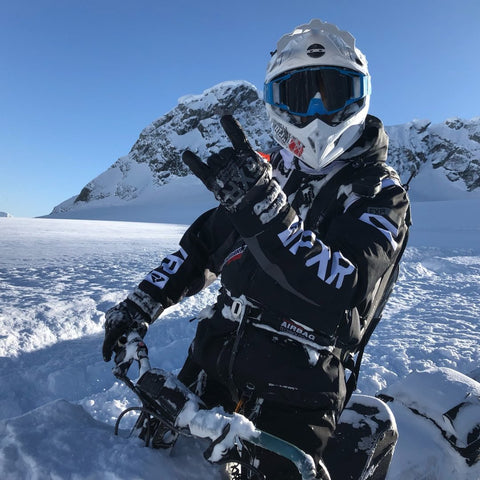
Duncan Lee
Duncan runs snowmobile riding clinics and avalanche education through Let's Ride Adventures, and has been part of the Deviant Ink crew since before Trevor and team took over the company. He grew up on the West Coast near Santa Cruz, lives where he can ride from his door, and has backed Boondock Nation's avalanche safety push at Out West Sled Fest from the start.
Show notes
- 3:35A first sled photo at age two in Colorado, then riding the snowed-in Tahoe neighborhood at 7,000 feet
- 6:35Starting Alpine Assassins in 2008, and why long-format sled films disappeared
- 9:47How the Sierra Avalanche Center pulled him into teaching, and why he only teaches motorized courses
- 12:15Digging a trench with the track to confirm the persistent weak layers in the advisory
- 14:05From nine years as an FXR athlete to FXR rep for the Mountain West
- 20:42The pre-ride checklist: assemble your group, check the advisory and weather, make a plan, check gear
- 26:00See it, feel it, touch it, watch it, ride it, taste it
- 30:10Using onX slope angle in the field, and where mapping software gets it wrong
- 33:42Over a foot of snow in 24 hours, rapid warming and the other red flags
- 35:46Running out of gas on the way to meet Jeremy Hanke in Revelstoke
- 48:52Shocks, bars and a can on a 154 Summit Expert Turbo R
- 52:30Second chair All-State tuba in Nevada
The motorized community has been underserved in avalanche education forever, and we still make up half of the fatalities.
Win a free custom wrap
Drop your email and what you ride. We draw winners all season and announce them on the show.
Doing snowpack tests is not a decision-making tool. It's just designed to gather data.
Questions answered in this episode
What should snowmobilers check before riding in avalanche terrain?
Duncan Lee's pre-ride routine: assemble your group and think about who has the right gear and training, check the avalanche advisory and the weather, make a plan for where you're going and what to avoid, then at the trailhead check your sled, essentials and tools. Before anyone gets on a sled, confirm everyone is wearing a transceiver with good batteries that can send and receive, and carrying a probe and shovel, then reconfirm the plan. 21:33
What are the red flags for avalanche danger while snowmobiling?
The number one red flag is recent avalanche activity in the past 24 hours, especially natural slides. After that, Duncan looks for signs of instability like shooting cracks, whumpfing and weak faceted grains, a persistent weak layer or persistent slab listed in the advisory, recent loading from new or wind-blown snow, and rapid warming. If you see them, avoid slopes over 30 degrees, obvious slide paths and anything with a terrain trap below it. 26:50
Can you decide a slope is safe from a snowpack test?
No. Duncan says snowpack tests like a compression test are for gathering data, not making decisions. A result that looks stable is not a green light to ratchet it up, especially when you know a weak layer is in the area. A test that shows reactivity, on the other hand, is a good reason to back off a slope you were planning to ride. 27:57
How much new snow makes avalanche danger a problem?
Duncan's rule of thumb: over a foot of snow in 24 hours is a big load on the existing snowpack, and you're dealing with a problem. Wind-blown snow counts as loading too. New snow problems like storm slabs and wind slabs heal faster than persistent slabs buried deeper in the snowpack. 33:42
When should you replace avalanche transceiver batteries?
Start with your manufacturer's manual. Duncan runs a Mammut transceiver and usually swaps batteries at about 50%, since a pack of batteries costs about six dollars. Transceivers use little power to send and more to receive, so practicing searches drains them faster. Even teaching a lot, he goes through about two sets a year. 24:44
If you think, while you're riding, what's above me, what's below me, what happens if this slides, you're going to make better decisions based on where you're at in terrain.
Full transcript58 minutes · 15 sections
Read it
Lightly edited for readability. Click any timestamp to jump the video to that moment.
0:00 Intro
All right, welcome back to another Sledder Cast podcast episode. We are in Island Park, Idaho.
Island Park, my favorite place in the world.
Is it?
It is.
That's awesome. I'm glad to be here with you, then.
Yeah, so am I.
We're at the Out West Sled Fest. It's a yearly event, and it keeps getting bigger and bigger every year. We just got done with the show and shine. I think we had 40 or 50 sleds out there. There was a ton. Sleds were looking dialed.
Pimped, right? Things were pimped out. People had them just iced out. There was a dude that was even sporting half a tree.
Yeah, he had half a tree between his ski loops, and he came literally right off the mountain with that tree.
Jake Dahl, yeah. And I think he got second place.
Second or third. Third, I think it was. Still a good-looking wrap.
It was great. Was that a Deviant Ink wrap on that?
Yeah, it was.
You know how I recognized it? Because it looked good.
Oh, wow. Hey, I wasn't expecting that one. Well, there we go. I'm surprised my wraps didn't win. They looked good too. We tried to stack the deck. We did our best.
It was fair. It was very fair.
There were a lot of cool wraps. Not as many holographic prints as I expected.
Well, it was also overcast, so it's kind of hard to get the full effect.
Oh, that's a good point. With no sun, the holographic stuff wouldn't be really shiny.
Anyways, I'm Trevor Erikson, one of the hosts of the program. We've got Mr. Duncan Lee in the building, and we've been trying to string this together since Hay Days. Hey, let's do the next show, the next show. One of them got cancelled, and we're like, hey, get over to Sled Fest, we'll get you taken care of and we'll do the pod then. And here we are.
We made it happen.
We have a great show lined up today. We're going to talk a lot about being avy savvy, get to know Duncan a little bit more, get to know a little bit more about his style. I'm curious what Tahoe is all about within the snowmobile scene. So it should be good. Duncan is also putting on the avalanche awareness training tomorrow here at Sled Fest, so we'll be attending that as well.
We're going to get into making smart decisions. We were out with Duncan yesterday, and just being around someone that has the knowledge and experience that you have made our group better. Like, hey, we should be asking these questions.
Yeah. It was a fun day of riding, and it's definitely sketchy out right now. Super sketchy, with cracking, whumpfing, instabilities and recent avalanches. So we had to make good decisions, otherwise we would have gotten in trouble.
One thing that I picked up on and appreciated was we looked at some terrain, and you said, is it greater than 30 degrees? And if it was, it was, let's check it out and see. And then it was, nah, I ain't messing with that today.
Yeah, just not messing with it today. I had a blast with you yesterday. It was fun riding.
Yeah, it was good. Ski tips up.
Yep. Standing up and having a blast.
3:35 Getting into snowmobiling
Awesome. Okay, Duncan, let's do it. For those of us out there in this world who don't know who you are, give us a little bit of background. How did you get into the scene of snowmobiling? What were you doing before, and what do you do occupation-wise that allows you to go out and do the things that you do?
A lot of that has changed over the years. I started snowmobiling, and there's a picture in Colorado, in some terrain that's now closed to motorized use, when I think I was two. We were out there with the family, visiting other family, and we were on sleds. Cool photo from back in the day. I guess that would have been around 1980.
You do the math right there, everyone.
Let's not do the math. Then when I was around 12, my dad got two snowmobiles. I grew up in the Lake Tahoe area. Our house was way above town, up on the mountain, like 7,000 or 8,000 feet, pretty far up there. We used to ride those sleds as young teenagers around the neighborhood when it snowed in, because the Sierra gets massive snowstorms. The driveway would get totally covered, you couldn't drive cars in the neighborhood, and the plows didn't come up and service us until the very last.
We used to rip those around the neighborhood and have super fun, and then we'd take them up to one spot, Mount Rose, and just ride meadows. It was cool, but the sleds then were difficult to ride, especially when you were little.
Oh, yeah.
Then around 2000, I was snowboarding like a maniac, just every day. College didn't work out. It was probably college's fault. But I came back and was a ski bum, so I was tuning skis every night and snowboarding every single day. I worked with a rep, and I was sponsored by K2 at the time, and I was super fired up. I was like, oh, I need a snowmobile to get out in the backcountry and ride more big stuff. That's where it's at.
So right around 2000 I scraped enough money together to buy a 144 800 RMK. We started getting out there, and my buddies were like, you're not going to bring your snowboard anymore. I'm like, you're right. Two seasons later, the sleds are going bigger, farther, we're jumping. I rode a lot of motocross at the time too, so it was like, oh, this is amazing. Powder turns up, down. Well, not much sideways, because of the old iron. But a lot of fun.
And the snowboard slowly went from 100 days a year to like 75, 50, 10. And now I really try and keep it at up to 10.
Up to 10. That's your development right there.
Pretty much, especially now with the new machines.
6:35 Starting Alpine Assassins
Then we did a bunch of filming. In 2008 we started Alpine Assassins, which was just a group of buddies getting out and filming. We thought we were Slednecks dudes, so we just started our own film brand, going around to some of the shows. We had a lot of fun, and that's all we kind of capitalized on.
So Alpine Assassins started in 2008, you said?
That's kind of when we came together to found it, and we weren't able to do a film until 2010. I want to say there are seven Alpine Assassins movies out there, which was a lot of fun. We kind of approached it from traveling and trips, showing the trials and tribulations of what we all do as snowmobilers, and just hunting for pow.
Why do you think there isn't an Alpine Assassins today, or Slednecks today? Is it because back then there was something you had to go purchase, like a VHS or a CD or a DVD, and now the barrier to entry is so easy? Do you think that's what it is?
I think people have a hard time sitting down for 45 minutes to watch snowmobiling, with today's format being very quick and instant, like a five-minute edit or less on YouTube. It's very weird. I don't know why it's kind of disappeared for the long-format films, which is sad, because I think they're really cool. Each person can do a segment all year and gather the story they want to make in that couple of minutes, and you put a bunch of those people together. I would love to see the return.
You guys were actually part of, I think with Backwoods at Hay Days, was it Power Hour? Were you guys a part of that?
Not us as a company, but we did have some of our athletes featured in the film, and that was really cool.
I thought that was a really cool way. Maybe we could see some more of that and get more people involved with making a segment from the season, because I think that would start to bring it back a little bit more. There are a few people out there doing some stuff.
I think we were talking about it last night, but it's hard to hold on to that footage. You go do something sick, you get back to the lodge or whatever, and you're like, let's get this loaded up now and post it. So it is kind of tough to hold on to that stuff. But it'd be pretty cool to see a return of it, because it allows you to write a story with the segment, as opposed to, look at this cool maneuver, just going from maneuver to maneuver.
True. You never know. We'll see where it goes.
We'll see what happens there. So we're in 2008, Alpine Assassins kicks off. That's kind of your entry ticket into, holy cow, look what these sleds can do.
Yeah, we were kind of doing it, and then once the Rev came out and I got an '04, we were like, whoa, this is rad. So we started pushing it, and then we started the film thing.
9:47 Becoming an avalanche educator
Through that, I was like, I think I want to start guiding and stuff. So I started getting avalanche education, which I had to take with my snowboard and snowshoes. Then at the time, the Sierra Avalanche Center reached out to me, because we were doing the Alpine Assassins thing and trying to make a name for ourselves. They said, hey, would you like to come help get some sleds to do this class with us and help us teach it? I'm like, okay, well, what does that look like for me? What do you want me to teach? How do I teach it?
I was lucky. Travis Feist, who's a mentor of mine in the avalanche community, is my boss at the Sierra Avalanche Center, and he coached me along the way and got me into the right courses. Then I went through AIARE, the American Institute for Avalanche Research and Education. I became a professional instructor, then an instructor trainer, and went through all the right hoops.
Actually, before becoming the instructor for that stuff, I became a course leader and instructor, which takes extra training beyond the AIARE standards. Those courses are designed to help you become a teacher, because you already have the education of what the avalanche situation is and how to move through terrain. But AIARE teaches you how to be a teacher, which is a pretty big step.
Oh, yeah.
So that helped, and we just started kicking things off. We've been teaching avalanche education at home for 10 years now.
Wow.
Which has been a lot of fun. I get to work right out on my sled.
With your classes and courses, is it 100% snowmobilers?
Snowmobilers or snow bikers. Motorized only. I will turn down any human-powered courses people ask me to do, just because the motorized community has been underserved in avalanche education forever, and we still make up half of the fatalities.
Yeah.
So it's just a goal of mine to help. And it's super fun. I get to ride and show people how fun riding is when you're making good decisions.
12:15 Quick snowpack checks to perform
We did some quick stuff yesterday, and I was surprised at how quick and easy it is to just get a lay of the land as far as what the snow's doing. It's not going to ruin your day at all. It's just a quick little thing.
Yeah, it's not rocket science, and yesterday was cool. Like I said, it's not rocket science. We looked into the snowpack really quick. We dug a trench with our track just to get our hands in the snow and confirm what they're talking about in the advisory, which is persistent weak layers. We looked at those facet grains and identified that they're there. You've got strong snow over weak snow. That is enough to confirm the advisory and say, hey, considerable and high avalanche danger means it's sketchy. We're likely to trigger an avalanche. Let's stay off the steep stuff. We can see it in this trench.
We did a quick snowpack test, like a compression test, just to check out what it's doing, but that's not designed to make decisions off of. We were just kind of poking around. We were seeing shooting cracks, we were feeling whumpfing and hearing whumpfs when we would get together, and those are big signs of instability. When you see all that stuff, it's easier to make good decisions. But you really have to wake up your perception and look for that stuff. If you don't look for it, you're not going to find it.
And if you look for it and don't find it, it doesn't mean it's not there.
It means maybe it's not happening exactly where you're at, right. So it takes constantly looking, constantly paying attention to what nature is telling you. But it's not a lot of things. We all do it anyways. I think it's waking people up to remember to look around and pull their head out of their dash.
Just making it a habit.
Yeah, exactly. It's a few easy steps.
Good stuff.
So that became work. I teach anywhere from 10 to 14 courses a year, not including awareness talks. It's fun. It's about 10 people a course, and we go out and ride. Most courses are three days of...
Wheelies.
Wheelies and test slopes.
There we go.
It's good times.
14:05 Repping FXR in the Mountain West
So that brings us up to today. You work with FXR, right? You signed a new gig there, and this was just recently, within the last year?
Right at Hay Days. We launched at Hay Days.
Tell us a little bit about what you guys launched at Hay Days and what your role is at FXR.
I've been an athlete with FXR for nine years. It's been awesome. They're great to work with, it's a great family. It's owned by Milt, it's a private company, and he crushes it. He does a great job. There are a ton of people that work there, and we seriously call it the FXR family. Everybody's really cool and works together, and it's a lot of fun, especially when they all get together. I've been out to headquarters a few times, and I really try to be active with my sponsor and make sure they're getting what they signed up for. Under-promise, over-produce.
That's a good model to live by.
Definitely. Over the years, in the mountains and on the West Coast, FXR is a huge brand. Our presence in the Midwest is massive. In the mountain scene we've got a bunch of great gear, but I feel like a lot of people aren't really aware of what we have. There have been some changes with reps. In March, a buddy of mine, Cory, who works at corporate, did a big tour and visited a bunch of dealers. I was like, hey, is FXR looking for a new rep? And he was kind of like, well, yeah. And I was like, what would happen if I put my hat in the ring? It kind of perked up some people, because we've worked together for so long and I have a great understanding of the line.
My wife and I chatted for about three months and really tried to dial in how and what, and make it right. We talked with corporate and really dialed it in. I wanted to make sure there were no red flags moving forward. So we dove in, and I took the repping job for the western United States.
Mountain West?
Mountain West, I guess. We split it between a few reps, but I have where I'm at in California, so Northern Cal, Oregon, Washington, northern Idaho, then Wyoming and Montana.
Interesting. So you don't cover southeast Idaho, around this area right here?
Utah. We still have a current rep doing Utah and south Idaho. We don't have a ton of dealers in that massive place. The West has less people than the Midwest, and our towns are very sporadically populated. Not few and far between, but very far between each town. So we're spread out.
But we're making another push. We've got some cool things coming out for next season. It's not going to be a big product launch, because our 30th anniversary is coming up. Or 25th or 30th, I can't remember. I think it's 30.
Better get that one right.
A big anniversary is coming up in 2026. But for next year we do have a new trilaminate shell jacket and shell bib coming out, just for backcountry riding.
Sweet.
I'm super psyched. I'm like, when do we get samples? Let's get it. I want to start getting it out there. I want to go to the dealers.
Are you wearing the samples and we just don't know about it?
No, not yet. I would show you. When that stuff gets out, I'm going to be back on the road hitting all the dealerships. To me it's just making relationships and introducing myself. I've been on a few tours to see the different dealers. I'm not a used car salesman. I'm more of a person-to-person type, like, hey, how's it going for you? How can I help?
And you started as an ambassador athlete, right? You didn't come up through the regular ranks.
Yeah, I don't think I'm a normal rep, for sure. So we'll see how it goes. I'm excited. We kind of planned out a three to five year scope, so it's not just, I don't think this works. We're all going to make it work.
And I'm psyched because we have a sick moto line. What's today? We've got Supercross coming up, I think it's San Diego, on Saturday. If you check the lineup, we've got a couple of rad teams in there. They're crushing it. I think we had a podium in San Francisco, even though it was a mud bog. Our moto gear is crushing it and making waves. It's pretty cool.
Not only that, we have a fishing line, full foul weather fishing gear, and a super lifestyle line, with really cool UPF, really lightweight shirts and shorts and shoes. There's no wonder the catalog is super big. And we do a mountain bike line. We've got a bunch of stuff, and it's sick. I love our stuff.
When I think of FXR, I don't think boring at all. I think the opposite of boring. It's kind of fun, very colorful. You stand out.
We have a wide range too, which is cool. There's a bunch of chill stuff. I kind of pick the less loud stuff, unless we're taking photos. My buddy James Cole and I nailed the cover shot for the catalog last year. Super bright outfit, looks great in pictures, matches the wraps you guys bust out. But we also have a line of pretty chill style with fewer logos, called the RYEX line. It's just mellower vibes. Not so loud and in your face.
Like 45-year-old vibes.
Right. Maybe more West Coast, old school snowboard vibes. But yeah, right now everything's 45-year-old vibes.
20:42 Pre-ride avy savvy checklist
Sweet. Well, this kind of transitions us over to our next segment. We wanted to talk about some avy savvy stuff, and the direction of the question was: what's the pre-ride checklist? Boom, boom, boom. Quick things that, as we're getting ready to hit the trail or the mountain, here are three to five things I mentally go over with myself and with the group.
Yep. So we'll go pre-ride list, and then a while-we-ride list. Pre-ride, everybody already does this, but taking avalanche education gives you a structure so you don't miss anything. That's when accidents happen, when we miss stuff. So structured, professional education by somebody who's been trained to teach is the best way to actually get this process down so you can repeat it and not miss stuff. And it doesn't take a lot of time.
So before you ride, every time, you call your buddies. That's assembling your group, right? Figure out who's going to go. Maybe today's not the day for you to ride, maybe tomorrow would be better. We always have that A team, B team, whoever those people are. Maybe Cody is not the guy we want, because he's always finding himself down in the creek at 4 p.m. trying to take that shortcut back to the truck. So you really have to think about what everybody brings to the table. Who's got the right gear, whose sled's always breaking down, who knows how to use the avalanche gear, who's taken training, who's not, what's the danger for the day, what does that all look like.
So we assemble our group and figure out who our partners are for the day. The next thing we do is check conditions, which means the avalanche advisory and the weather. Looking at that is going to tell you what the avalanche conditions are and what the snowpack is like. We probably have a mental note of what's going on: where's the powder, where's the good riding, and what should we avoid because avalanches could be possible or likely. What does that look like, and what should we be looking for while we ride?
Then the weather. What are we packing? On a storm day I'm going to pack different stuff than on a sunny day, and on a cold day I'm going to pack different stuff than on a warm day, and those all mix together. All that stuff then comes into our plan, which is the next thing we do: where we're going, what our route is like and what we need to look out for that day. Those are quick things we already do, but that's the type of structure we teach.
Once we get to the trailhead, we check our gear. That comes down to oil, gas, checking your sled, replacing that A-arm you bent last time. Make sure you're topped off on the essentials: food, water, snacks, tools. For most of us, you've got to make sure one guy packs the tools for you.
Well, it depends on what sled he's on.
Oh, that's true. Just kidding, they all break down. He's got to be part of it. You've got to have him.
They're always part of the crew.
Of course. The guy that knows how to wrench. Then outside comms, all that stuff. And before you get on the sleds: transceivers, probes and shovels on your person. Transceivers worn underneath your outermost layer, or in a zippered pocket, not a cargo pocket, or in a manufactured pocket. A lot of the vests now have a specific transceiver pocket, the monosuits have one, and some of the pants. In FXR we have a specific transceiver pocket with a lanyard location inside the zipper, as well as a little elastic sleeve that keeps the transceiver in place so it's not bouncing around.
You've got to check battery life and the send and receive functions, so you know everybody's transceiver can do all the things it needs to do.
Kind of a random question. For Duncan, when the battery life gets to a certain percentage or bars, where are you swapping it out?
It's really best to read your manual to find out what your manufacturer suggests for your transceiver. Because I teach so much, I let my batteries get pretty low. I run a Mammut transceiver. I can leave the parking lot with 30%, but I probably switch them at 50, just because a pack of three batteries is like six bucks, so I'd rather not have to worry about it.
Transceivers don't use a lot of energy to send a signal. They use a lot of energy to receive a signal. So if you practice a bunch, you'll use up more battery. But I still only go through maybe two sets of batteries a year, and I teach a bunch, so my transceiver is in search for demos and we practice a bunch. So it goes pretty good.
Then as far as checking probes and shovels, just a quick assembly if you've never ridden with somebody, to make sure one, they know how to do it, and two, that they have it. But if it's your normal crew and you trust your buddies, it's like, hey, you still got your stuff in your pack? Sweet. Same pack? Okay, right on.
After you check that stuff and everybody's good to go, you reconfirm the plan, where your first stop's going to be, and then take off and ride, right? And that brings us into the while-we-ride portion.
26:00 While-you-ride avy savvy checks
We're always looking at a few different things while we're out there. Actually, in my awareness talks I break it down into a few different steps: see it, watch it... oh, sorry, I did that wrong. I don't have it memorized. I use PowerPoint.
Yeah, yeah.
I'm 45, give me a break. See it: you're visually checking things out as you get there. Feel it: you take off, and what's the snow feel like? Touch it: get your hands in the snow, find out what's going on in the snowpack, and confirm whether what the advisory is talking about is there. Watch it: watch your buddy get on something, hopefully something small that can't bury them, and see what the reactivity is. We call that a test slope. Ride it: then you get to ride it. And then my favorite one, taste it. That means game on. Pow days, face shots, tea party on. You've got to taste it.
You do. Love it.
That's to break the ice and have some fun. Formally, when you're out there, you really want to look for recent avalanche activity. That is the number one red flag. If you're seeing recent avalanche activity, meaning in the past 24 hours, then you want to know what aspect and what elevation it went on, what it slid on, what the weak layer is and what caused it. If it's a natural avalanche, that means it's likely for you to trigger. If nature's doing it on its own, add us to the slope and you've got a problem.
Add a trigger, and boom.
Yeah. So if you're seeing natural avalanches, chances are they're repeatable. Big heads up.
After that, you want to look for other signs of instability: getting your hands in the snow and looking for weak faceted grains like we did, looking for shooting cracks, looking for small pockets breaking off on test slopes, or even doing snowpack tests if you have the knowledge from taking a class.
And again, doing snowpack tests is not a decision-making tool. It's just designed to gather data. I would never do a snowpack test, get a result that implies stability, and then be like, oh, let's ratchet it up and go hit that slope, because then you're just looking for the opportunity of a green light. I would rather do a snowpack test and say, well, this doesn't confirm anything because it didn't give us the right results, even though we know this layer is in the area and we confirmed there's a weak layer underneath the strong slab. We're still going to play it safe, and maybe I'll go do some more and see what those results are.
Or maybe our day was, hey, it seems pretty good, we're dealing with this problem, we were going to get on this slope. Then we do a snowpack test, see some reactivity, and go, whoa, we're actually not going to go do that now.
Those are probably your more dangerous times in the backcountry, when a report might say something, your brain says, hey, we're good today, you don't do any actual tests in the area you're riding, and you find yourself a little more loose with your judgment. Versus, hey, I'm on edge today because the reports are saying it's high danger.
Right. It's easier to make good decisions when the reports are considerable or high. Considerable gets tricky, because you might not see good evidence, but you're likely to trigger something. And at the moderate danger level you probably won't see evidence, depending on the problem, but it's still possible to trigger something.
The biggest killer is a persistent slab problem. That's where you've got loose, weak grains under the snowpack that take a long time to change, and that's what's going on around here right now. We have some persistent weak layers, and they don't always give you good evidence. Right now there's good evidence, but they don't always do that. Then you get on something, and the only evidence you get is when you trigger an avalanche. That's what gets people the most. The most fatalities are from a persistent slab problem.
30:10 Checking slope angle with onX
Now, do you use onX at all?
I do. I was actually just talking with the GM out in the parking lot about onX and how great their product is. I also use a couple of others.
Let me walk you through this scenario, because the slope angle feature in onX is something I look at when I'm on the computer. I'm looking for new terrain, I pull up my slope angle, and it gives me my colors that tell me, okay, this is between 30 and 35, or 35 to 40.
Now you're out there and you see a natural slide. Maybe you can eyeball it and say that's a 40 degree angle, it slid on 40. If I have my onX app and I'm standing right there, looking at what just slid, and it's showing me that's 35 or 40 or whatever it is, I see that color, and I can now look all around me and say, all of this right here that we can see, this slid, so all of this is going to slide too.
It could slide, depending on what's going on in the snowpack.
And that's a quick little check.
Sure. That would be a great way to use that tool. But with all mapping software, it's very hard for them to get detailed down to the specific slope. So you'll find in certain situations the map might say a certain slope angle for an area, but when you're actually there, it might be a little off. Just fair warning. It's a great generalization tool. If you start to thread the needle on the map and then try to do that in real life, you might find yourself in the wrong spot.
Like, let me put a pin here, here and here. Okay, checkpoint, boom. And you're like, oh, there's avalanche terrain here and here. But then in the real world you're like, oh, that's actually the whole thing.
Yeah. It's a great app and a great tool, and what you explained is actually a great way to use it, because you can double check things and see, oh yeah, that is 40 degrees. Okay, cool.
The other great tool is just the measuring app on your phone. You can actually shoot slope angles and shoot alpha angles. And the best way to get an eye for it is just to practice all the time. In classes I like to do side bets: hey, how steep do you guys think this slope is? Everybody throws in their answer, and then I give out a prize.
That's a good test right there, for sure.
32:46 Persistent layers, loading and warming
So we missed a couple of things in the while-we're-riding part. After we look for other signs of instability: if they list a persistent problem in the advisory, that's a red flag, because that means you have a difficult-to-understand problem with not a lot of signs, and it's the one that kills the most people. If you read persistent weak layer or persistent slab in an advisory, that's already like, okay, things are scary. Now you've got to understand exactly where it lives, what aspect, what elevation. If you don't have an advisory, you've got to go dig down and try to find it. You have to understand what's happening in the snowpack, so it takes more knowledge if you're going to go ride where there's no advisory.
After that, you're looking for recent loading, which comes in the form of wind blowing snow, new snow, wind blowing new snow, or just a new storm dumping. If you get over a foot of snow in 24 hours, that's a pretty big load on the current snow.
I was going to ask that question. What is that number?
If it's a foot, you're dealing with a problem. That's just how it is. And new snow problems, like a storm slab or wind slab, heal quicker than things buried in the snowpack, like a persistent slab or deep persistent slab.
Then after that, you're dealing with rapid warming. If it's warming up, a quick change in temperature, whether it's solar or just ambient temperature, can have big effects on the snowpack, usually from the top down. Basically, say you have a buried persistent weak layer, and the sun comes out and it goes from 25 degrees to 32 degrees. You've got a big change really quick, and that'll condense the top snow and probably make things more touchy. But you'll see signs like pinwheels or rollerballs, and all the snow releasing out of the trees in the sun, which is kind of what happened up here.
We were in the negatives the first part of the week, the roads were frozen, and now the roads are wet. That's a sign right there. You don't have to be out in avalanche terrain to see this stuff.
So those are the big things while we're riding. Those are the red flags. If you see that stuff, then you need to make decisions and avoid more avalanche terrain: slopes over 30 degrees, obvious slide paths, anything with a terrain trap below it.
A great thing I learned from a good friend of mine, Jeremy Hanke, was: what's above me, what's below me, what happens if this slides? He probably said that in the podcast with you guys.
It was a long one. I haven't been through the whole thing. I'd have to check.
It's a great situational awareness reminder. If you think, while you're riding, what's above me, what's below me, what happens if this slides, you're going to make better decisions based on where you're at in terrain.
I love that. It's good.
I'm definitely plagiarizing the hell out of it from him. He won't mind. He loves me.
35:46 How Duncan met Jeremy Hanke
You want to know what's funny, how I met him? He didn't tell you this story?
He didn't. Okay.
So the Sierra Avalanche Center had done Throttle Decisions, out of Canada. Jeremy's been a big part of Throttle Decisions, the video series about motorized avalanche education. Great stuff. If you want to go online and watch some quick, easy how-tos, check that stuff out. And then go sign up for Jeremy's new product, which is online avalanche education. That stuff is sick.
He's crushing it.
He is changing the game. You can pay in and use it for courses, so other instructors can use it too. It's going to be great modular stuff.
It's awesome, and it's entertaining too.
Well, he's an entertaining guy. It's all a show. We're just a bunch of entertainers around here. Comedians, sometimes.
So we had all this footage, and we wanted to have it edited by the Throttle Decisions crew. We reached out to the editors and got in touch with Jeremy and the Sierra Avalanche Center, and it was, hey Duncan, can you get this hard drive to Jeremy? I'm like, yeah. So I'm calling him: hey, I'm coming to Revelstoke. I'd been up there for a couple of years before I met him. He's like, oh yeah, you can just come up and drop that off at my house.
I got to talking to him a little bit, and he's like, I rent part of my house out. I'm like, oh, you got anybody staying for the week? Because I'd love to come up and just ride. He's like, no. I'm like, well... He's like, well, you can just crash. I'm like, really?
So I called my buddies and picked them up. At the time it was Luke and Ethan Taylor. Rip, Luke, miss you, buddy. We drive up and show up at Jeremy's door, and he's actually out riding. We were going to meet him. We ran out of gas on the way to this riding spot way north of town. We didn't realize it was 60 miles. So we hitchhike back to town, get diesel, get the trucks filled up, and go find him on this really horrible information he gave us, to this not-real trailhead. We drive out this Canadian logging road, find their trucks, park, follow their tracks. We're in deep. We get out there, and he's like, no way. I'm like, yo, what's up, I'm Duncan. He's like, yeah, well, duh. Who else would make it out here? I can't believe you guys even made it this far.
I'm like, dude, we're committed. I wanted to meet you, and I know you guys know where the goods are. He's been in Revy for, I don't know, 25 or 30 years. Him and Alfred have done a lot of pioneering there, which is pretty rad. So I show up with other buddies, we crash on the couch, take rooms, and I just said, yeah, I'm moving in, I'm hanging out. I gave him no choice to say no, and he's pretty rough, you know.
So you forced that friendship.
Totally. He loves me. We're pretty tight. I used to call him the angry Canadian, but he's really changing his ways, and he's a lovely, positive guy now. I feel like I had something to do with that. Just trying to make a difference.
Sweet.
It's been a lot of fun. So then I would go up every spring and stay a month at his place. I would spend the whole month of April, because my wife would go guide in foreign countries, and I was like, well, I'm not going to stay in Tahoe and just ride slush. I'll go up to Canada, where it dumps three feet and goes bluebird in springtime, and I'm staying at your house. And he's like, yeah, I'll see you there.
There you go.
It's a great program to be on. I'm pretty lucky. I don't think everybody gets that. And then we started doing awareness talks together, which are a riot. He has slapped me across the face pretty hard, because we had a bet going. I said "beacon."
Wow.
And he got me. I got him too, but I was much nicer. I just kind of lightly tapped him.
You're saying beacon instead of transceiver.
Yeah. He's got a big thing about that.
I've got to watch that back now and see if I said that, and see if he just flinched.
He might have. He's a great guy, very passionate about what he does.
Yeah.
Did I derail us?
39:52 Where Duncan's style comes from
No, we're good. We're good, because I want to talk about your style.
Oh, okay.
We've had other people tell us, have you ever ridden with Duncan before? Dude's got style. And you're 45, right?
Yeah, I'm 45.
And still riding with style. And the natural question is, well, when I'm 45, I'd like to still be doing the stuff that you're doing. I rode with you yesterday.
I think you will be.
We'll see about that. But are you just built different, or is this a product of something you've done repeatedly for a while that gives you longevity in the sport and lets you carry it further? Because you don't look like you're winding down much. Look at this, you've got a little war wound right here and you're still sending it.
I wasn't even doing anything. I was taking a turn. It's interesting. I'm flattered when people say I have style, because personally I think style is the coolest thing, and that's what sets us apart individually. Everybody can do a wheelie. So many people can do this and that. If you just jump off something straight and go massive, that's cool. But if you jump off something massive and give a little tweak, or add a little flair, then that's cool.
I think honestly it's just part of how I grew up: skateboarding, riding BMX jumps and doing whips, and then in moto and snowboarding.
So you probably got your style from that background.
I would slash turns on snowboards and ride big lines, just trying to paint the mountains differently. I always try to view something like, okay, people might go do that, but I'm looking for this obscure thing that maybe nobody else is going to hit. It's super fun to me, and I think that keeps me interested, putting my flair on it.
But when people say that, I'm just like, do I really have that much style? I feel like I'm just smiling and having fun, like, I'm going to go this way.
Is there anything you can think of that you maybe subconsciously do to build style?
I would say, honestly, start small, and that's with everything. Start small, work on something, then turn it up a notch and work on it again. Let's take jumping. If you're going to put some style on a jump, you build a jump and hit it once. Okay, I feel good about the distance. Then you hit it again, maybe off the side of it, and you give it a little something, and you work on that a little bit. Oh, okay, cool, I know when I fly sideways a little bit I've got to correct. I'm not doing a whip, but a little flare out, or leaning over the bars.
I think Caleb has talked about it a little bit. He does his stand-up, lean-forward deal, which looks really cool, because then he looks taller and more aggressive in his stance. Whereas I look at some photos of me and I'm bent down. I'm getting this hunchback thing going as I get older. Bent down by the bars, and it's a totally different look. I can see what looks cool about Caleb: you can see the space between him and the bars. I look at some of my shots and go, oh yeah, I need to do more of that, because I'm all crunched into it. But when I'm in the air, I'm like, oh, this feels so cool. I think that's maybe the style thing for me. It just feels good.
That's your style.
And start small. There's another buddy of mine, Justin Sheath. We call it the Sheath leg. We actually learned it from Josh Roth. Rip, brother, miss him too. Roth was kicking his leg way out doing these sidehill maneuvers, getting it up in a wheelie and just kicking that leg way out. Then we started calling it the Sheath leg, because his leg is in every picture, way out.
Dang.
I think they called it danglin' at one time.
Danglin'. Do people still say that?
I mean, the word exists.
There you go.
44:58 Staying fit and riding hard at 45
And you're pretty fit. You're 45 and fit, man.
Taking care of the body, trying to. I'm pretty broken over the years. I've got bumps, bruises, screws and plates, just like everybody else that likes to play hard. But rehab is huge on your bones and muscles, and trying to stay fit. Luckily I have a wife that's way into working out, and she keeps me in shape.
She cracks the whip.
She cracks the whip on me to make sure I'm not slacking. She loves to work out. We get to go ride together, snowboard together, mountain bike together, all kinds of fun stuff. We've got a four-year-old, almost four, and he keeps us in shape too. Got to chase him.
And eating healthy. As I'm aging and learning what that brings on, it's all about eating really well and making sure you're not just eating junk. Trying to cut out sugar, which is really difficult.
Have you been saving that? Did you have this plan? Holy smokes, that was clutch right there.
Entertainer. There you go. Always thinking: what's above me, what's below me, what's going to happen when this thing falls.
There you go.
When I'm done, I might have another one. But yeah, I definitely used to drink a fair amount when I was younger. The ski and snowboard scene out in Tahoe is pretty rowdy. I met my wife in a bar, which was cool, back before dating apps and social media, so it was a real live connection. But I really try to tame that down these days, because it just doesn't feel good at all. And I've missed a couple of epic rides with some big dogs because I was hungover, and that's dumb.
We all make mistakes, right? Live and learn.
Live and learn. Trying to stay healthy and stay fit. I like to be able to dance around the sled and keep up with these young guys. Geez, they just rip.
They do. But you do a great job.
Thank you. It's fun, whipping a bow tie and then staring at your buddy who was following you, like, what's up? You didn't see that coming.
I think that happened to us yesterday.
Oh, yeah. You got right up in my business. My bad.
It's a lot of fun. My dad gives me a bunch of crap about being so broken over the years. He's like, you're going to hurt. I'm like, well, probably, so I'm just not going to stop. Because if I stop, I figure it'll just escalate quicker. I feel like I've toned down a lot.
Probably have.
I still love to jump stuff. It's so much fun, but I'm really selective about what the landing's like. Out with the Boondock Nation guys, Jack's been sending it, Dylan's been sending it, and sometimes Jack just airs to flat, but if it's deep... What is he, in his 20s?
I think so.
So I'm like, oh, that looked like fun, but no, I'm good. Two years ago we were sending a pretty fat jump, like a 150-foot big roller, with a long way down to at least some transition. I'm very selective. I definitely don't do what I used to, for sure.
I don't think I'll ever do a backflip.
If you do, let us know. We'll be there.
Okay, now there's too much pressure, so I'm probably going to say no. Those guys, man, it's so sick to watch. My buddy Cody is just... There are a lot of people doing them too. It's crazy. It just looks normal now. A couple of guys figure it out, and then all of a sudden it's part of the program.
It's cool.
48:52 Duncan's top 3 Ski-Doo mods
Where are we at with your questions?
Guess where we're at. We're down to the fun spot. We're down to the lightning round. Woo, ding, ding, ding. I don't even know if you scrolled down this far.
I might have, buddy. Maybe not.
Okay, so in the lightning round we ask the same two questions to everyone. The first question: you have a brand new Ski-Doo. What are you riding, and if you only get three mods you can do to that machine, what are those three? And the last question is, tell us something you think most, if not all, of your followers don't know about you.
I've got a bunch of those.
Sweet. We want the secret stuff. The deep stuff.
Okay.
So, first question. It can't be a wrap. A wrap does not count. We're not throwing wraps on here. What sled are you picking?
Well, I just got a 146 Turbo R Freeride, but I think I'll just stick with the 154 Summit Expert. It's just awesome, a little more capable. The 146 just wheelies everywhere, which is really fun, but let's go practical. Most people would be on a 154.
So we're on a 154 Expert Turbo R.
Turbo R. Here we go.
Three mods.
Shocks, hands down. T-Motion skid in the rear, torsion delete, full Fox adjustable. That's number one.
Okay.
Cockpit: bars. I'm just changing it up this year. I started doing a two-inch riser with a Boondocker 2.0 from Cheetah Factory Racing, so I have a total of four inches of rise off the steering post. I used to run a three-inch riser, and I'm like, ooh, two inches lower. Feels really good. I like the sweep of the Boondocker too. They've got a bunch of options, but that would definitely be number two.
Okay. Suspension, cockpit, third one.
Man, I've got to pick between a can or skis.
You only get three, man.
I know, it's tough.
Speak now or forever hold your peace. What could you not ride without, out of those two?
Man, stock sleds are pretty rideable these days. But for the fun, I think I'd just throw the sound on it, because it's just singing. I'm a motorhead. I love a motor sounding cool. Like a stock sled with a GGB kind of tuned-up sound, I'm going to be like, ooh, that sounds nice. You don't get performance gains out of just a can, but you drop a ton of weight, and that sound...
I don't run the mountain can, because it's blow-your-brains-out loud. The trail can, with a good tune, sounds pissed off. It's cool. It's loud, but a nice loud, I think. And then the quiet can, if you want to drop the weight, is not much louder than stock. It's got a crisp little bark to it, and you're not going to blow anybody's eardrums out, which is cool.
So the can comes in third. Shocks, bars, can.
Can.
52:30 Duncan's secret, and wrap-up
Okay. Now, what's that dirty secret? What's the thing no one knows about you?
In high school I was second chair All-State Nevada tuba player.
Tuba?
Yes, sir.
That was not what I was thinking. I was thinking, like, track, 100 meter.
No. Tuba. Second chair, All-State.
Cali?
Nevada. I grew up in Nevada. I was into it. We did this thing called Tuba Christmas at the mall every year in Reno. Rip malls.
Are they done? When's the last time you went to a mall?
There we go. Christmas, 1995. We would have like 30 tubas, and I think I was the youngest most of the time, and we'd all play Christmas carols. I was in the marching band too.
You were in the marching band with the tuba? The sousaphone?
The sousaphone. My mom's got pictures, I'm sure. I weighed like 99 pounds as a freshman in high school, so they had to get this extended mouthpiece, and I'd carry the tuba, and all you could see was legs when we were marching. They called me the tuba with legs.
That's funny.
It's fun. Playing music is amazing. I used to play the trumpet, and I was doing jazz band and stuff, and it knocked out my front teeth in sixth grade.
From the trumpet?
No, I was riding a bicycle.
Oh, okay.
Front wheel problem, there you go. Woke up in Reno. So they're like, well, you don't have any front teeth to support a mouthpiece, so how about the tuba mouthpiece? I'm like, oh, that works. So then I was playing tuba in the high school band as an eighth grader. It's fun. I think music is great. It gives you rhythm and makes you have fun. So yeah, it's tuba. Tuba man, I'm all about it. I don't play it anymore, but I bet I could maybe take some lessons again.
I would expect nothing less from someone like you.
You never know. Try anything.
Okay, well, the cameraman's giving us the signal. What's it telling us?
We're dying. Our batteries are dying.
There we go. And I think you might be a little hungry. What does this mean? Wrap it up, boys, wrap it up.
What was the code word? I'm thirsty, get me a drink, please.
Oh, right. Okay, well, tell you what, man, it's been awesome.
I'm not going to shake with this one, I broke it. We'll do a lefty. Thank you guys so much for bringing us up here and letting us come crash with you. It's fun to see you guys in your natural habitat and hang out some more.
So glad we were able to make it happen.
Me too. It's been a long time coming.
So more to come. I think we'll do this some more at some point, or at least ride together. And for all you guys out there, thanks for tuning in. This is another dope podcast, Sledder Cast, going down, and we'll be at it live all week. 99.5, nothing but the hot hits. Just kidding.