
We made it back to the States just in time to head down to the SnoWest Utah Snowmobile Show, where we sat down with MTN.TOP athlete and ambassador Justin (JT) Cox and talked about all things snowbiking.
JT shares his advice for snowmobilers looking to get into snowbiking, how to be a good brand ambassador, what's new with the 2024 MTN.TOP Transfer snow bike kit, what it's like working for a company like Fox, what it was like being one of the first ambassadors for a brand new snow bike company, and what the future of snowbiking might look like.
Guest
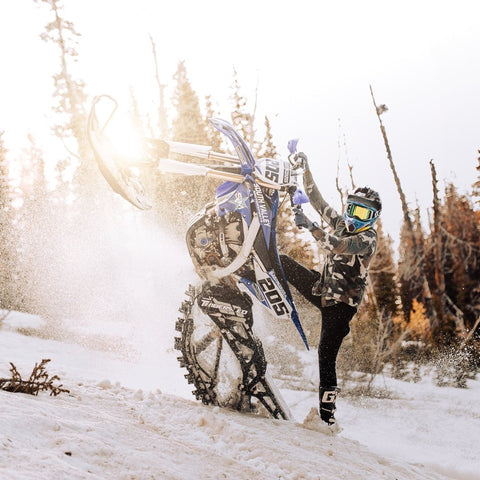
Justin Cox
Justin, known as JT, is a third-generation snowmobiler from Shelley, Idaho, who grew up on dirt bikes and sleds and switched to a snow bike in 2016. He got into the motorsport industry at South Valley Motorsports in Utah and is now Fox's outside sales rep for Idaho and Montana, based in Boise. He rode Timbersled before joining MTN.TOP's first wave of athletes, working with founder Allen Mangum on the Transfer kit.
Show notes
- 1:05A third-generation snowmobiler from Shelley, Idaho, now a Fox outside sales rep for Idaho and Montana
- 3:04Going from the rider asking for sponsorship to the brand rep getting asked
- 4:12Why creating value for the brand is what makes an ambassador work
- 6:20Laughing off snow bikes in 2011, then buying a $3,000 kit in 2016
- 8:26One machine that works 12 months a year, and more quality days on low snow
- 10:24Trevor's first snow bike day in Island Park, and the light bulb moment in the trees
- 14:07Joining MTN.TOP's first wave of athletes with Timbersled founder Allen Mangum
- 18:58What changed on the 2024 Transfer 129, including the new 3.25 inch track
- 22:43Why durability matters more than weight on a snow bike
- 25:32How to try snowbiking the right way: ride with snow bikers, not a flat-field demo
- 28:11Where snowbiking goes next, with YETI back, MTN.TOP new and no ceiling
- 31:13JT's three must-haves on a new bike: thermostat, snow shed, intake
For the same investment as a snowmobile, I had a machine that worked 12 months out of the year.
Win a free custom wrap
Drop your email and what you ride. We draw winners all season and announce them on the show.
These days it's creating value for the brand. Figuring out what they need and what you need, and then making sure that those two align.
Questions answered in this episode
How do you become a good brand ambassador for a powersports brand?
JT Cox, who now sits on the brand side as a Fox outside sales rep, says it comes down to creating value for the brand: figure out what the company needs and what you need, make sure the two line up, and then deliver. In his words, most people show up asking what a brand can do for them, and the riders who last are the ones giving back as much as they get. 4:12
What's new on the 2024 MTN.TOP Transfer 129 snow bike kit?
According to JT, the frame and Transfer skid carry over from the first-year 2023 kit, with the first-year quirks and growing pains addressed. The big change for 2024 is a three and a quarter inch track with a three and a half inch pitch, up from the two and a half inch track he rode in 2023. 18:58
Who owns MTN.TOP snow bikes?
MTN.TOP is owned by Allen Mangum, who also started Timbersled. JT Cox was part of MTN.TOP's first wave of athletes for the 2023 season, after getting to know Allen through his earlier time on Timbersled. 14:57
How should a snowmobiler get into snowbiking?
JT's advice is to make your first ride a real one: go with snow bikers, where snow bikers ride, instead of a demo in a flat field, which is where a snow bike feels least impressive. Then, because a snow bike isn't a turnkey machine, get coaching on the setup from a regional shop or snow bike athletes, who he says will happily share what they know, so your money and time go in the right direction. 25:32
What are the must-have mods for a new snow bike?
JT's three non-negotiables are a thermostat (with a temp gauge so you can see it), an engine jacket or slide plates to shed snow off the engine, and a customized intake to keep snow out. He says those are actual must-haves on a snow bike, not wants. 31:13
Go with snow bikers where snow bikers go. You get the real effect, and not a demo ride in a flat field.
Full transcript39 minutes · 14 sections
Read it
Lightly edited for readability. Click any timestamp to jump the video to that moment.
0:00 Intro
All right, hey, welcome to another episode of the Sledder Cast podcast. I'm Trevor Erikson, one of the hosts of the program. We're at another show this weekend. Last weekend we were up in Canada, now we're down in Utah at the Utah Snowmobile Show, put on by SnoWest. Today we have Mr. JT Cox with us. We've been working with JT for a few years now, one of the epic MTN.TOP snow bikers out there.
We're going to get into his story and learn a little bit more about the MTN.TOP kit and what the differences are between an MTN.TOP kit and some of the other competitors out there, which is kind of fun because it's a newer kit. Last year was the first year. So I'm going to learn more about MTN.TOP in general, we're going to learn more about JT, and we're going to learn about snowbiking in general. We're excited to get that kicked off.
1:05 From southeast Idaho to Fox
So JT, why don't you just give us kind of a brief intro. Who the heck is JT Cox?
Yeah, thanks for having me, by the way. Justin Cox. I'm born and raised in southeast Idaho.
Shelley, to be exact, right?
Yeah, right down the road from you guys. I grew up riding dirt bikes and snowmobiles. It was a family affair, a deep passion for snowmobiling from my grandpa down to me and my brother. Life revolved around it and evolved from that.
Cool. And you're now in Boise, correct? So what are you doing over there in Boise? You used to work somewhere else, and now you're with Fox.
Yep.
So what do you do there at Fox?
I'm the outside sales rep for Idaho and Montana. So I go to your local motocross dealers and dirt bike dealers, and lifestyle and even mountain bike, and make sure that they have what they need and are up to date on the product, and represent the brand all the way through.
How did that job come to pass? How did you get that job?
It started eight, ten years ago. I was working at South Valley Motorsports, and that's how I got into the motorsport industry. That's what brought me down to Utah from home. Ironically, the parts manager that hired me at South Valley went to work for Fox, and called me up ten years later and said, hey, there's an opportunity in this region, you should think about applying for it. It all kind of accelerated from that really fast.
3:04 Inside Fox, and what brands want from riders
So you were a Fox consumer before?
Oh yeah, for years.
You were on the outside of the company, now you're on the inside. What's maybe the biggest surprise, where you're like, oh, I didn't know that, now I'm on the inside and I can see it? Is there something like that you can think of?
I think the biggest thing is I've always been the person trying to get the next thing, like, how do I ride for you? It's interesting to flip the script and have people coming to you asking how you can help them. It's been fun to be able to do it when you can, but it comes at you so fast and from so many people, it's hard to connect the dots sometimes. That was probably the biggest eye opener.
Have you been able to see a connection from your side, like, hey, this type of person has a higher success rate or an easier chance to work with a company like Fox?
Dude, honestly, I think these days it's creating value for the brand. Figuring out what they need and what you need, and then making sure that those two align, and being able to provide value for it. And I think that goes way beyond just Fox, obviously. Everybody. Just making sure, what are your goals, what are my goals, and then let's collaborate and make sure that we're both fulfilled and getting where we want.
Yeah. And we see this. Every company here goes through the same thing. So many people come up to you and it's all about, hey, what can you do for me, I need this. And as a company you're sitting there thinking, all right, what are you going to do in return for us? How are we going to make this a partnership, a collaboration, one where we're happy to work with you and you're happy to work with us?
And JT, we've worked with you now for a couple years, and you've been very vocal on, hey, I want to make sure that I'm providing you as much value as you're giving me. And then going and doing that. So I think you've mastered that concept pretty well, and it's cool to see at Fox.
5:37 From third-generation snowmobiler to snow biker
But before Fox, you were a snowmobiler, right? You started on snowmobiles.
Oh yeah.
Okay. So you grew up on bikes, you had that history, but in the winter you were recreating on snowmobiles. So when was your very first experience on a snow bike?
It was kind of a big chain of events that unfolded over a few years. Starting from third-generation snowmobiler, deep passion from Grandpa, Dad, my uncle and then my brother. I got into motorcycles and into the motorsport industry because it paid the bills. It was something I could do for seven months out of the year. But snowmobiling was where the deep passion lived.
When snow bikes came about, they were kind of like a Tote Gote. I remember the first person who said, dude, you're a good dirt biker, you should look into this. And I laughed in his face, straight up. I was like, yeah, that's not me. I ride the dirt bike, I ride the snowmobile, I like them, and I like them separated.
And this was roughly when?
Maybe 2011.
Dang, okay.
I got the idea, but it wasn't a snowmobile and it wasn't a dirt bike, and it hadn't evolved to where it is now. Thankfully I didn't ride one then, because it would have changed the trajectory of my life. It would have been more of what snow bikes were in 2011, and it wouldn't have aligned with where I wanted to be.
Then a few years go by. I'm in my 20s, paying for all my own stuff, and I don't have the access to a snowmobile. I could justify the price of a dirt bike that I could ride seven or eight months out of the year, instead of a snowmobile that sat in the garage for seven or eight months. But then I got to a place where I was almost resenting winter, because I wasn't participating in it. I finally said, I'm doing something.
My friend rode a snow bike for the first time and came back so excited. He's like, dude, this is the real deal, you've got to try this. And this was in 2016.
So now it's years later.
Exactly.
So a lot could have changed by then.
A lot. Revolutionary, basically. He's like, yeah, we're going to start selling them. You already have the dirt bike, throw a $3,000 kit on it. And I was like, you know what, I'll try it. It'll get me through a winter. It didn't take very long for me to realize that for the same investment as a snowmobile, I had a machine that worked 12 months out of the year.
Very economical there.
Yeah. And from there I actually got to ride more days of quality riding. On the days that the snow is less than ideal for a snowmobile, it's still pretty good on a snow bike. That was when it was like, okay, this is the real value for me, I can get extra days on the snow of quality riding, because it was so much more versatile. So this is the real deal. And the next year I built a snow bike that cost as much as a snowmobile.
So that threw that one out of the way real quick. Okay, so from 2016 on, your first choice on snow was a snow bike? Is that how we would call it?
Yes. I bought that snow bike off my buddy's recommendation. I had to write a check and wait all winter on this decision, never having ridden one, ever. And I ride it down the trail and I'm like, oh my gosh, what did I just buy? It literally feels like I'm riding a Tote Gote down the trail. Then I got it in the timber and instantly, okay, I get this.
Then it was the first time I rode at home in my backyard where I grew up. My dad had a house right on the foothills in Idaho, so we could ride right from the house. And I was riding zones in my backyard that I had never accessed, on dirt or snow. That was game on day right there. I'd never been able to hit that zone. It was an epic zone, but there wasn't enough snow coverage for a snowmobile.
That's for sure. Game on point. That's cool.
10:24 Trevor's first snow bike day in Island Park
So my experience on a snow bike has been one time, last season.
Right, in Island Park.
Yes. And it was epic snow conditions. I know those guys, and they're like, dude, if we're riding, you've got to be on a bike, you're not taking a snowmobile with us. So I was looking at the snow, and I'm like, this would be one of the most epic days on a snowmobile. That's what I'm going into this day with. And holy crap, I told this story in a previous episode, besides losing my cell phone in the middle of the backcountry, that was a dang fun day.
I don't ride a lot of dirt bike. I know how to ride a dirt bike, I just don't spend many days a year on one, so I was a little nervous. The funny story is, we're looking at what you'd maybe call the eastern mountain range if you're up there in Island Park, and they're like, where should we go? I'm like, we should go over there. And they're like, well, how do we get there? And I'm like, well, we can go across the flats and then kind of go through some drainages and make our way up. And Kody Kirkland was like, no dude, we're just going to go here and sidehill all the way across and get over there. Whatever we come across, we'll figure it out when we get there.
That's not how you think on a snowmobile, because it's full of trees. So they got me into some pretty gnarly stuff. My anxiety meter went up a few times that day. Being in such deep powder, I was used to that on a snowmobile. But where the light bulb went off for me was on the way out. You drop elevation quite a bit, and then you have gradual elevation down through the trees. Pillows, tight trees. On a snowmobile you're just picking your way slow, strategically cruising. On the bikes, that was when it was like, oh, so this is what it's like. That was my light bulb moment of, okay, I get it now. I get why you would choose to do this.
Yeah, and why they wanted you to leave the sled at home.
Exactly. And I'm a sledder still. I love them. I'm not the person that converted and said I'm never going back. But that day, when you're with the boys on snow bikes and you're crushing it, it's fun to have everybody in alignment. You just barrel off of descents and don't think about it to the depth of, okay, I need a plan A, B and C on this. Like, a plan A and half a B, I'll roll the odds on this.
There was some crazy stuff, like a big creek drainage where I'm just like, we are done, we're staying the night here, boys. And they're like, no, we'll just build a little platform right here and bunny hop this, and then we'll cruise right out. And I'm like, I'm going to watch you guys do this. And I had it all on film, but it's on my phone that's still in the mountains somewhere. So I have two of those experiences where it was an epic day and the phone's still out there somewhere. Someone's going to find it.
14:07 Joining MTN.TOP's first wave
So you started on a Timbersled kit back in the day, right? And then last year you were part of the first wave of athletes for MTN.TOP. So what's that like? You get a new company popping up. How do you buy into that and switch from a proven name, a proven brand that's been out there in the industry?
For me, because of my time prior, I'd had the opportunity to get to know Allen.
And Allen, for those who don't know, is Allen Mangum, the owner of MTN.TOP, correct? And he also started Timbersled.
Yep. So I had a deep respect for him, and our passion for the creation and evolution of the snow bike aligned really well. As soon as I heard about the project he was working on, I was like, I want to help. I want to participate in this. How can I contribute?
For me that was right at the same time as I was going to Fox, and I knew I was going into a corporate position. I've always flown by the seat of my pants, never had a plan, just absorbed life. And I was worried about my life being too structured and too deep in work, on top of going out and playing on the athletic side of things. That transition has been really refreshing, being able to have a collaborative effort. If I see a place for improvement, I can call him specifically and say, hey dude, let's look into this part. And sometimes he's already ahead of me, like, let me share with you what I've got on this.
So it's been extremely exciting for me, with the creative mindset that I have, to be able to exercise that. And our team is very close-knit and family oriented in a lot of regards. It's been exciting and honestly an honor to even be considered for that.
That's awesome. So being part of that first wave last year, the first run at it, how has the team transformed? Year two, do you still have that close-knit family vibe?
Yeah, for sure. It's been strong, and if anything better over the last year. We're having more time to collaborate. I've spent more time with my friend Darren Teal. We've been teammates for years, and last year was the first time we rode together that wasn't on a photo shoot or for work. We blasted three whole separate weekends and got to share the experience for fun. I think it's brought him and me a lot closer.
And to me, that's what it's all about. That goes back to that third-generation snowmobiling. You go out on the weekends with your family and your friends, and that's still today my favorite type of riding.
Just with your crew, not having a mission or something you have to accomplish for someone else while you're out there. Now we're just here for the experience today, guys.
Yeah. And doing our media stuff last year, it was literally just another ride. The photo comes out, the video comes out, and we had a goal to hit, but it was still a fun ride with a lot of high-fiving. Not that it always is that way, but it was just a little bit more like a typical weekend ride.
18:24 The 2024 MTN.TOP Transfer 129
Okay, so let's talk about the MTN.TOP Transfer 129. That's the kit, right?
Yeah.
So the MTN.TOP Transfer 129, 2023 versus 2024. Let's start there. Are there any big noticeable differences you can speak about, or is it pretty much the same kit, just refined?
A few things. So 23 to 24, the Transfer skid technology, the frame, everything we've been riding since 23 has just been polished up. You've got your first year of quirks and growing pains, for lack of a better word, so that stuff's all been addressed. But ultimately the kit's been the same.
The new claim to fame this year is a three and a quarter inch track with a three and a half inch pitch. Coming from three-inchers going to two and a half, I was very concerned about being able to be the leader in the group and punch a trail with three or four guys on my back that are on three-inchers, and creating congestion in a hairy situation. And the two and a half performed phenomenally. It never felt like it held me back. There were a couple places where I'd get stuck where others wouldn't, but it wasn't holding the group up or causing congestion. So that was great. And now we've got three and a quarter. I can't even begin to tell you the excitement. With how well the two and a half did, I'm so excited to see what the three and a quarter does.
Add that extra link there. And she's over there right now, so we'll probably splice in some photos and some videos here. JT brought this kit to the show completely naked, all black.
Yep.
And she looks just a little bit different right now.
Yeah, we put some glitter on her, just a little bit. It's been a showstopper for sure. People are digging it over there.
So we'll get some close-ups of that and throw it in here into the video.
20:44 Why choose MTN.TOP
Okay, so that's kind of the differences between the 23 and the 24 kit. Now let's say I'm a snow biker, and I'm not really married to a brand, because it's not just Timbersled versus MTN.TOP. There are a few other companies out there. Let's say I'm not married to a certain brand and I'm open to exploring. Why would I choose to go MTN.TOP? With your experience, because you're not just an MTN.TOP-only guy, you've been on some other platforms, why would someone like me choose it?
For me, MTN.TOP comes down to the versatility of the unit. In the past I've had two different applications: one for an exploring, guiding, leading day, and then a rowdy, go huck this thing off of stuff setup. And you could do the overlap, and that was great, there's nothing wrong with that. This kit, though, has been perfect for a versatile experience, especially for someone that doesn't know what they want. You can have that confidence-inspiring feeling and still get rowdy when you want, on a little bit sharper level than what I'd been used to. So that would be the versatility, allowing you to grow and figure out what you like. Does that make sense?
Yeah. And then just get on the gas pedal on that aspect of the sport, and you've got a machine that will allow you to do that.
Correct. And the way my bike is set up, it's pretty in between. With some body English I can get it to activate and be lively, or with less body English and a little less athletic activity, I can turn my head and not worry about it darting off the trail.
22:43 Weight versus durability on a snow bike
So a question that I have as kind of an outsider of the snowbiking industry. As snow bikers, are we as concerned about weight in the kit as we are with snowmobiles? And is there much of a difference in weight between different snow bike manufacturers? Is that looked at like how we look at different snowmobile manufacturers, or do they all kind of look the same and therefore the weight's kind of the same? Should we be focusing on weight?
It's a blend. There's what we experienced in the snowmobile industry a few years ago, where the snowmobile got so light that the durability wasn't matching up. I would say durability is king from most snow bikers' perspective. Most of them are packing a lot more luggage on them, because we don't have built-in luggage pieces, so we're used to adding it. I run pretty minimalistic storage, and that's how I shed my weight, not to mention that kit is naturally a little bit on the lighter side. So yes, it's a factor, but I wouldn't say people are grinding edges off or putting titanium bolts on these yet to get those changes.
I'd say another variable is efficiency, maximizing the efficiency of the track so that it's not bogging down the motor. But durability, in my opinion, is key. Making sure the durability is there to get you out of those hairy situations we talked about. You break that machine down and it's a different day. It gets extremely hard, because you've got to figure out how to get something in there to fix the problem.
And they're a little bit harder to drag out.
Yes. At least they come apart in two pieces, so you can tear the whole thing down, throw it on a sled and pull it out.
Cool. So that's definitely durability.
24:46 Advice for getting into snowbiking
Okay, now the sport in general. What advice do you have? I know you shared your own experience, and there's advice in that. But what would be your advice for a noob, someone who's like, I'm open to this, I'm a sledder but I'm open to this, I ride dirt bikes? Because it's not like you just walk up and buy your 850 from the shop. Unless you're buying it off someone who has the kit built, there's some work that goes into it. You've got to make it a snow bike.
For sure. I would start all the way from the first experience, the first ride, just like what Kody and those guys gifted you with. Nothing against the snowmobilers, but go with snow bikers where snow bikers go. You get the real effect, and not a demo ride in a flat field, because that's where the snow bike is probably the least appetizing. Truly go experience what the snow bike experience is, with snow bikers.
Yes, because that's important. You guys are a different breed, man. You guys are recruiting people. Snowmobilers are like, if you're stuck, figure it out on your own, man, I'm going to go do this. But dude, those guys were stoked for me when they could see that I was enjoying myself. They were like, heck yeah. So make sure it's a snow bike specific day that you're going to have with guys who are snow bikers, because you guys are just a bunch of recruiters out there.
Oh, for sure. I feel like there's less of that, let's go crush them and get them stuck and leave them and humble them. It's more uplifting. It's fun, high fives, and if we're stuck, let's get it out and get through this section, and build on that vibe. You had a very good experience with the crew you were with. They're just incredible.
So to get back on topic, the first part is getting the rider a good experience right off the bat, to truly experience it. And then two, like you said, the bike is not a turnkey setup, so make sure that you're getting coaching on the machinery, so you're investing your dollars and your time in the right direction. There are so many great resources, and it seems like every region has a good anchor out there, all the way from Colorado to Canada.
And that's another thing. You reach out to any of these snow bike athletes and they're going to share their knowledge with you, or say, go talk to my guy over here. Darren, you can call him up and he'll fully hook you up, mentally or with educational stuff, and then connect you from there.
Love it.
28:11 The future of snowbiking
Okay, so let's get JT's outlook. We'll do this as a two-part question. The next two years, where do you see the sport of snowbiking? We snap our fingers, we're two years ahead. What's your prediction, or what would you like it to be in the next two years?
I feel like it's going to be pretty exciting. The more people that are getting engaged in this, the better. You've got MTN.TOP adding in, they're the new kids on the block. You already have Timbersled, you already have YETI coming back again, bought back by the original owners, and CMX crushing it. So the technology and the bikes are getting better. In two years we'll already have a phenomenal trajectory.
I think five years is going to be really incredible, because we haven't even embarked on the actual, let's turn this thing into a true snowmobile-style turnkey thing.
So what are you hinting at, that there may be two things combining into one?
Not necessarily. I'm just implying you have two totally different avenues that are pretty incredible. You can keep it the dirt bike, keep the one-investment-for-the-whole-year concept. Or there's the ceiling. That's what got me into snow bikes. There's no ceiling here. We can take this anywhere we want to go. There are people here at the show that have a snowmobile engine in a single-ski snow bike machine. It's not a new concept, but there's no ceiling there. We can build our foundations and our blocks all the way up in that category. We haven't even tapped into the depth of what that could be.
When you put that 850 in that machine right there, it'll be bonkers. Can you imagine?
Holy smokes. Look at that Boost right there on the other side of these cameras. It's incredible what it does, and you put it in that chassis and it'll be even more. I'm not saying that it's happening, I'm just saying that would be nice. There's no ceiling.
30:38 Lightning round: three must-haves for a new snow bike
So we do kind of a fun thing at the end of every episode. We call it our lightning round, but it's not quite so much a lightning round. We just call it that. We ask the same two questions.
Question number one. An MTN.TOP Transfer 129 shows up at the dealer, and JT goes and picks it up and gets his bike. They're both clean, naked, nothing on them. What are the first three must-haves, the first three things you're doing to that brand new snow bike?
We're going to start with a thermostat, to keep the temperatures regulated. Number two, to help combat the snow, is going to be an engine jacket or SXS slide plates. It acts as a skid plate. And number three is going to be, I just drew a blank. Thermostat, engine snow shed, and then intake. We're going to keep the intake customized a little bit more like a snowmobile, to keep the snow out. And that's literally what that bike has right there. Thermostat, snow shed, intake.
That's a little bit of a different way to answer that question, talking to a snow biker versus snowmobilers. Some of the things sledders put on, we think are necessities, but they're kind of wants. Whereas on a snow bike, those are non-negotiable. They're actual must-haves.
That's non-negotiable for me. If you build a bike for me, it will have all three of those, and a temp gauge on the thermostat so you're actually seeing it.
Okay, I like it. So that was lightning round number one.
32:23 What people don't know about JT: a plant-based diet
Lightning round question two, JT. This is where we get personal. We get deep. We're going into the archives here, we're looking for something juicy. What's something that social media, or people in the industry who know you as JT Cox, don't know about you? What's a secret?
That one's a hard one, because I'm a pretty open book. You call me and ask me anything in regards to this world or snow bikes, I'm a pretty open book. It took me a second to think about that, but I adopted a plant-based diet about two and a half years ago. It's not something I share. Primarily plant-based. I still love steak and stuff like that, I'll eat it sparingly, like once or twice a month. But it's not something I express much.
It's been the best pain management I've had, eliminating the inflammatory foods out of my diet. As most of my following knows, I shattered both heels in 2013 and had severe chronic pain that followed that, to the point where I walked like an old cowboy for years. That was probably the most pivotal thing. But I don't share it with people, because it seems personal. It's been pretty incredible, though.
Okay, so a follow-up question. We're not being very lightning round here, but I've got to ask this one. Give me a regular day since you've adopted plant-based. What does a typical day of food consumption look like for you?
Well, I've always loved to eat. I'm an emotional eater or whatever, I love doing it for the enjoyment of it, so I eat a lot of food. Typically I start off with a Shakeology. It's a meal replacement, and it has everything you need for the day in regards to your base, so I start the day off with that. Then I eat lots of beans and lentils and that sort of thing for lunch. And then usually Steph and I will make a good, healthy dinner, again based around a lot of carbs, like potatoes. Obviously potatoes, being from Idaho too.
And you've done this for how long?
I started in 2020.
So this is just the way life is for you now. You don't even think twice about it.
Yeah. It was pretty pivotal, again coming from a place where meat and potatoes was literally the main part of your diet. In 2020, everybody's lives were going to change, right? Steph and I adopted it together, so for our whole household it was really easy to just change it. And it was fun. It was something we were doing at home, and we were eating foods we had never eaten before, mixing these types of vegetables and stuff like that. So it was exciting for that time, when we were stuck at home. Then life got back to normal, and that was my new normal, for lack of a better word. I still have a steak and stuff like that, but it just flipped the nutritional pyramid upside down, I guess.
Cool. Well, thanks for sharing that. Now we know.
36:09 Where to follow JT Cox
Okay, so JT Cox, where can people go follow you? What channels are you on, and what else do you have going on in the space where people can engage and learn from you?
Instagram's my main platform, so that's Justin Cox 205. I kept it simple all the way through, so Facebook and TikTok are both Justin Cox 205 too. I haven't been engaging with them as much, but we'll get back into it. It seems like I always ramp up again in the winter. And then Relentless Riders on YouTube. We'll have to expand that a little bit more next winter. But primarily Instagram, Justin Cox 205.
Okay, awesome. All right, hey, thanks for hanging out with us today. Once again, we're at the Utah Snowmobile Show in Sandy, Utah, and there are people roaming around all over the place. People are excited for the snow. It's probably going to be dropping snow here, hopefully in a couple weeks. If it's anything like last year, fingers crossed.
It was incredible.
And we'll all be out on a mountain somewhere. All right, thanks, guys.
Cheers.