
We have a fantastic conversation with Frank Tousignant, the founder and owner of Carbon Pursuit. Frank shares what inspired him to launch Carbon Pursuit and how his background in composites shapes the way he crafts high-end carbon fiber sled parts.
Recorded at Hay Days, the conversation covers the biggest challenges he's faced bootstrapping a business out of his garage, how Carbon Pursuit prototypes and tests its products, the new headlight delete kits for the Matryx and Catalyst, and what's next for Carbon Pursuit.
Guest
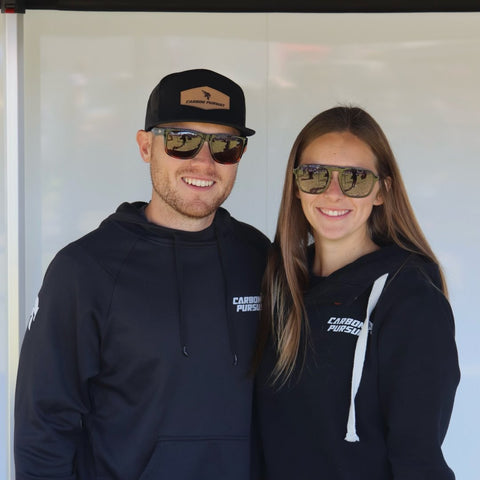
Frank Tousignant
Frank grew up trail riding in Minnesota, earned a degree in composite materials engineering at Winona State University and spent a couple of years building large composite parts for an aviation company. He started Carbon Pursuit in his garage with a carbon rail brace for his Arctic Cat Alpha. With his wife Leah he has grown it into a family business making prepreg, oven-cured carbon fiber headlight deletes, belt guards, skid plates and bracing for mountain sleds.
Show notes
- 4:30Growing up a Minnesota trail rider and studying composite materials engineering
- 6:20The first product: a carbon rail brace for his Arctic Cat Alpha
- 7:44A year of testing with the Freshies Built crew at Seeley Lake
- 9:15From the Hay Days swaps in 2022 to a third year in the vendor area
- 10:45The Polaris Matryx headlight delete that put Carbon Pursuit on the map
- 12:28Why every part is designed to bolt into the stock holes
- 14:02The lonely road: garage shifts at 11 p.m. after a day job
- 19:27First look at the new Arctic Cat Catalyst headlight delete, about 2.5 lb lighter
- 23:38Prepreg, vacuum bags and oven curing, and why it matters at 30 below
- 25:42Carbon vs. aluminum: roughly twice the strength at half the weight
- 30:57Why free test parts come with a catch, and the riders who test for real
- 35:19Lightning round: headlight delete, clutching and a lighter can
I might not be the smartest guy, I might not be the most talented, but if I truly outwork everybody that I can, I will get to where I want to be.
Win a free custom wrap
Drop your email and what you ride. We draw winners all season and announce them on the show.
If you're a backcountry rider, you don't have to look past Carbon Pursuit because it's got carbon in the name. We can find something that fits the budget of your build.
Questions answered in this episode
Who founded Carbon Pursuit?
Frank Tousignant, a Minnesota snowmobiler with a degree in composite materials engineering. After a couple of years building large composite parts for an aviation company, he started Carbon Pursuit out of his garage, and he runs it as a family business with his wife, Leah. His first product was a carbon rail brace for his Arctic Cat Alpha. 4:13
How much weight does a Carbon Pursuit headlight delete save?
Frank says the new Arctic Cat Catalyst headlight delete saves just over two and a half pounds. On the Polaris Matryx it saves just over three pounds against the original headlight, and a couple of pounds against the lighter headlight Polaris introduced later. At the time of recording, the headlight deletes were 175 dollars. 20:21
How does Carbon Pursuit make its carbon fiber parts?
With prepreg, carbon fabric that comes with the resin already in it and has to be kept frozen. Frank cuts the shapes, lays them up in a carbon fiber mold, compresses the part under a vacuum bag and cures it overnight in an oven. He says oven-cured, high-temperature resin holds up to both under-hood heat and 30 below, and the prepreg keeps the part as light as possible. 18:53
Is carbon fiber stronger than aluminum?
As a rough rule of thumb, Frank says a carbon fiber bar of the same thickness as an aluminum bar is about twice as strong at about half the weight, as long as good high-performance materials are used and the resin to fiber ratio is dialed in. 25:42
Can you get Carbon Pursuit parts in colors?
Mostly no. Colored carbon parts use dyed fiberglass or Kevlar woven with the black carbon, and stocking every color in freezers was too costly for a small shop with a long build process. Frank builds in black, will build a colored part if he has leftover material in that color, and sometimes builds one-offs in a bigger checkerboard-style weave. 26:44
At 10 or 11 at night, when the kids finally settle down, hey, I got to go out in the garage and I got to work, and then I got to get up and do my day job.
Full transcript43 minutes · 12 sections
Read it
Lightly edited for readability. Click any timestamp to jump the video to that moment.
0:00 Intro
What's up, ladies and gents. We're back with another Sledder Cast giveaway. We are dropping the Carbon Pursuit episode, and Frank was kind enough to hook us up with a headlight delete kit. So whether you're on a Gen 5 Ski-Doo, a Polaris Matryx or an Arctic Cat Catalyst, we're giving away a headlight delete kit. I think these are like 175, maybe 200 bucks. We're giving one of those away. All you got to do is hit the link below and enter the giveaway. It's going to take you 3 to 5 seconds, is all. Let's go.
All right, hey, welcome back to another Season 2 episode of the Sledder Cast podcast. We're going to play with the sun today.
Yep. Who knows how it's going to shake out.
Looks like I'm going to take the brunt of it, I think.
Yeah, I'm going to try to tuck into the shade here.
We might be sitting on each other's laps here before we know it. But I got Frank Tousignant here, and his name's tricky, but we did some practicing.
Yep, we got her dialed in.
We got her dialed in. Tousignant. And if you don't know, I mean, it sounds like an easy name to say, but if you look at it, it's not an easy name to say.
Yep, we got a couple extra letters in that one.
Yeah. So Frank's the owner, founder, creator, builder of Carbon Pursuit. You've done a few podcasts. You did SledSend last year at Hay Days.
Yep.
They moved closer to us. Literally, we could probably shoot them with a squirt gun if we wanted to.
Right, right through the trailer.
Right out the back door.
Yeah, right out the back door. Mess with them a little bit.
But we have a fun discussion going on today. We've got sleds moving around, we're still working the booth here, and Frank's got to get back to his booth as well.
Next door to the Cboys this year.
Yeah, right across. So it should be hopefully busy over there.
Should be a lot of foot traffic, I would think. Hopefully get some new eyes into the booth and intelligently speak to the products we sell.
Yeah, that's awesome. So Frank, knowing the conversation that we're going to have today, and also knowing that we're human and our attention spans are just dropping like crazy, we're talking to that person who's just swiping right now. They stumble across maybe our thumbnail or a little reel or something. What can you say to that person that's going to get them to stop and tune in to this episode?
Yeah, I would say we got sleds, we got carbon fiber, and then we got the trials and tribulations of a small business, bootstrapping a business from the ground up. I think there's a lot of audience that can relate to that, family business, things like that. So not only is it sled talk, but there's a lot else that goes on in this small niche industry that I think can captivate the minds of a lot of people.
Yeah. So to give a little background here, maybe I can tease some of this up. I thought you were a cool dude from day one. I think you initially reached out and were like, hey, I've got this company. And you weren't assumptive, like, hey, hook me up. There wasn't a free hand there. I saw you at Hay Days that year, out hustling the swaps with Carbon Pursuit.
Although we're not close in proximity, from afar I feel like I've watched a cool process, being in the swaps, and we'll talk more about this later on in the episode, but you got some dudes, some dogs, riding for you.
Yes, we definitely have been blessed with riders adopting our parts and collabing with us and things like that. That's been a huge part of the process here.
4:10 The inspiration for starting Carbon Pursuit
So on your side of things, what inspired you to start Carbon Pursuit?
Yeah, so I've always loved snowmobiles. I've always been a snowmobiler. I grew up here in Minnesota, growing up trail riding, things like that, but never got to be a racer. That was never in my opportunities throughout my childhood. I didn't get introduced to the West until I was probably 18, 19 years old, so 10 years ago, somewhere in there.
So you're a young buck, man. You're not even in the 30s.
I just turned 30 this year, so I've crossed over that threshold now. But for me, growing up around sleds and always enjoying that, and then I went off to school to do composite materials engineering. During that process it was kind of like, hey, this could be my opportunity to combine something that I have a passion for from an industry standpoint, in snowmobiling, with something that I'm looking to do from a career standpoint, carbon fiber composites, and bring those together.
During school we were looking at sleds, and we did a carbon fiber ski during a school project, things like that, just to see what we could do. That's largely where my interests have always been.
Interest plus curiosity.
Exactly. And then from a background standpoint, when I got out of school I kind of put the hobby on pause. I went to work for an aviation company doing big composites for them. I did that for a couple years and truly enjoyed it, got to build a lot of cool stuff, and really learned how to build composites the aviation world style instead of so much the hobby maker style. If anybody wants to talk about how I build parts, and we might get into that, there's a difference in how I build. It's one way to do it in this world of carbon fiber composites.
Then fast forward a little bit, I'm riding my own sled, I got introduced to the West, and I've always been a Cat guy. I had an Alpha, and that rail can sometimes catch us. We should say the shock setup on an Alpha rail is a big part of it, but it's nice to have that additional security of a rail brace. So that was my first endeavor, and I've just kind of rolled with it from there.
So was that Alpha One rail kind of where the light bulb clicked for you, where you're like, hey, I've got a skill set here, there's a problem that should be solved, let me see if I can go solve that problem?
Exactly. And before that, it was watching companies like NextTech rails make carbon fiber rails, and there was C3 Powersports, I believe that was around for a while. They were doing some carbon work back in maybe the early to mid 2000s. I saw those companies and I was like, that's super cool, that's the stuff I know how to do, I could build that stuff. And then like you said, with that Alpha One rail, it was, hey, I can help this. I know the properties of materials and what can benefit this, and how big and how strong we should build it, so we can give a rider a solution that meets the needs.
So if you go back to that first Alpha One rail that you did, compared to today's version of it, how has it changed? Has it changed much?
So our rail brace, we updated this year. We ran the original rail brace, and I did a year of testing. I was fortunate to have Chase do some testing for me. He was one of the first people to put their foot down with Carbon Pursuit and really help me out there, which is great. I can't thank him enough.
How did you get hooked up with him?
I was lucky enough that Seeley Lake was a spot to go ride, and I hooked up with Freshies Built and got to ride with Chase and Ry Wadsworth and then Kyle out there. Those guys took me under their wings. That was one of my first in-this-industry groups of people that made me feel at home. At the time I was a nobody. I was just this small guy, and I'm still this small guy building shop parts out of my garage. But those guys didn't have to go out of their way for me, and they did.
So that gained enough testing to know, yeah, this works. These guys are beating the hell out of it and it's working good. And then that was kind of like, hey, let's try to roll this as a business and not just parts for myself.
9:00 Progression and breakthrough moments
Yeah, that's cool. When I was getting ready for this podcast, I listened back again to the episode you did with SledSend, with the boys over there. So it's cool to be sitting here in the shade with you, because I was inspired, man, hearing your story and, like I said, watching it along the way. Super inspiring. So as far as the progression goes, 2022?
Yep, 2022.
Was that your first year and last year with Carbon Pursuit in the swaps?
Yeah, 2022 was first and last. We did 2022 in the swap, and then 2023, last year, we moved to a spot, and this would be our third year in the vendor area.
Okay. So how has that progression been? Getting hooked up with those guys is a big break, right? But has there been anything else you can recall? There's a lot of luck that has to come into play when you're starting a business. Any of those lucky moments, breaks?
Yeah, for me I've always just been a believer in hard work and outworking as many people as I can. That's been my motto in life. I might not be the smartest guy, I might not be the most talented, but if I truly outwork everybody that I can, I will get to where I want to be. That's the approach I've taken with this. It's a ground-up business out of my garage, building high-end performance parts and trying to sell to the niche market of snowmobiling.
Like I said, we've had unbelievable riders that have been willing to work with us, and from a footprint and reach standpoint, getting our parts in front of people, that's been huge. Social media has been great.
From a parts progression, the Polaris Matryx headlight delete last year was the one. That was a new niche within this market. We had done bracing, we had done skid plates and things like that, and those had done well, but there was nothing like that. It totally expanded the people that know who Carbon Pursuit is. That Polaris Matryx headlight delete last season really helped let people know that, hey, Carbon Pursuit's out there and they're building these cool parts and we can save weight.
We've had a lot of great stories of people smashing up hoods and the headlight delete survives. I think that really starts to instill this confidence of, whoa, this guy knows how to build stuff. It's high quality, it's a good price and I can afford it. I think there's been a stigma in this industry of, oh, carbon fiber, that's crazy, I can't put that on my sled. And a goal of mine has been to try to bridge that gap. If you're a backcountry rider, you don't have to look past Carbon Pursuit because it's got carbon in the name. We can find something that fits the budget of your build.
For sure. And before we hit record here, I was telling you I'm not much of a tinkerer. I don't tinker on machines, so my stuff needs to just work for me, or I'm kind of in trouble. But we threw, what, three or four of the headlight deletes on the Matryx, and it was like five minutes and they're all done. It is so quick and easy. I don't know, maybe that's just a normal way to think through the process of development, but it truly is. We used the same holes, same placement, same location. Everything is the exact same. Pop it out, pop it in.
Yeah, that's been a big part of my core values within Carbon Pursuit, trying to make the customer's life easy. Trying not to be something where at the end of the install process the curse words have flown and the YouTube videos had to come out, and it's, oh my gosh, I would never do this again. The part's great, but it was a brutal install.
Kind of like the first time you wrap a sled, right? You're like, I'm never doing that again.
Patience, right. But yeah, using as many existing holes as possible. The great thing with carbon fiber is I can provide strength without having to add a bunch of holes, add a bunch of hardware and beef things up. I can say, hey, here's stock, and if I can hit those holes and make that work from a geometry standpoint, I can provide a lot of strength, save a lot of weight, and the install should be easy.
Doing a good job, man. Doing a good job.
13:31 The biggest challenge
So, starting a small business.
Yes.
I would say a lot of companies here are right in our shoes. Small business, right?
Yeah, I think this industry has been founded on a lot of companies starting from the ground up.
On the business side, what's been the biggest challenge for you to overcome?
Yeah, I think if you talk to anybody within this industry that has started something themselves from the ground up, they would say there's that long road that's lonely. It's just you at the end of the day. You're the only guy in the garage, you're the only guy designing parts, you're the only guy going through this whole process, and there's no part of that that's easy. If you don't have that grind, that work ethic, the motivation to do whatever it takes to work through the wee hours of the night and all that stuff, it's really hard to make that go, because it'd be easier to not do it.
So I think one of the biggest challenges for me is just maintaining that. At 10 or 11 at night, when the kids finally settle down, hey, I got to go out in the garage and I got to work, and then I got to get up and do my day job. That's all part of it. But if you're going to make something of it, I got to go wide open. I can't go half throttle at it, otherwise we wouldn't get to where we're hoping to be.
Yeah. No one sees what you do in the dark, what you do or don't do. No one sees if you cut it short and you don't go through with it.
Yeah, exactly.
No one sees the amount of time that you actually do put in.
Exactly.
Most people are hoping for your failure.
Yes. Oh, that's a huge part of this. And it's not until the success happens that it's like, yeah, now you're noticing. But this whole time, the last three years, I was grinding the whole time.
Right. There's a saying that I really like, where you're going to be in an auditorium by yourself for a long time, just clapping for yourself. Just one guy.
That is so true. Clapping, and there's nobody else saying, hey, you got to do this, we're cheering for you. There's great people that at certain times throughout the journey give you that burst of, oh man, this is great. But then that fades, and you're right back to where you were, of, okay, it's just me again.
And there's so much to learn. My family owns businesses and things like that, but I have to learn how to run my own business. There's building carbon fiber parts and selling and things like that, which I can do, but there's so much more to a business. When you're a person of one, it's, okay, I got to learn all these things that maybe I don't want to learn, but in order to run a business I got to figure that out, because there's nobody else to do those things.
Exactly. Love it. There's a quote, I can't remember who said it, but you've got to look past your self-doubt as an entrepreneur. One moment you're like, I can do freaking anything, no one can stop me. Two minutes later you're like, I'm the worst, this sucks, it's a terrible thing.
One thing that has stuck out to me, though, is you've got all these people out here talking, saying whatever they're saying, and you got to ask yourself the question: how many of them are going to be at my funeral?
Yes. That's a great way to put it.
And chances are you're going to say zero of them are going to be there. So why the heck do I care what they think or say?
Blinders on. You got to do it for yourself. At the end of the day, whatever your reasons are that motivate you, those have to be the reasons you do it. For me with Carbon Pursuit, like I said, it's a passion for carbon fiber, it's a passion for sleds, and then it's for my family. I got a wife and two small kids, a three-year-old and a nine-month-old. For me, I want my family to know that Dad worked his ass off to get to where we're at, and nothing was handed to us. There's a pride level, a respect level, that I want my kids to feel, and say, hey, Dad worked really hard to build something that hopefully lasts.
Yeah. That's the best schooling they're going to get, man, right there.
18:12 Carbon fiber basics and the new Catalyst headlight delete
Well, let's talk about carbon fiber.
Let's do it.
Like I said, I'm fully transparent, I don't know much about carbon fiber. Generally speaking, I know what it looks like. But I've seen some videos, and what you begin with does not look anything like what you end with.
No. So like I said, there's some different ways to do it. A lot of people might build things through dry fiber and wet resin, infusing that together, vacuuming the wet resin into the dry fiber and then curing under vacuum. I do it a little bit different. My material is called prepreg. It comes in a sheet that already has the resin in it, with film on both sides, and then it's frozen. It has to stay in the freezer, because the minute it comes out of the freezer that resin kind of kicks and starts curing. So in order to have any sort of shelf life, it's got to be stored in freezers. That's where it starts. It comes on a big roll, you roll it out, cut your shapes and start building within a mold.
Gotcha. Okay, so talk to me about what we got here. I haven't seen this before.
Yep, this is brand new. This is our headlight delete for the Catalyst, the new Cat. It's a brand new one this year, and I'm pretty excited about this one, because when you start taking the Cat hood apart and you take that headlight out, it leaves you a pretty big hole to try to fill, and there's not a lot of great mounting locations. So from a design standpoint, trying to have something that looks good and is aesthetically appealing to the customer, but also truly works from an install standpoint, was a little bit of a challenge. And I think we hopefully came up with something that people are going to really like.
On the sled, I really like it. I'm a big fan of mod-looking sleds, especially growing up here in the Midwest, mod snocross sleds and things like that. So I think we did a pretty good job of that. It's light. There's a lot of weight to be saved. I think we're saving just over two and a half pounds with this, and we charge 175 bucks for our headlight deletes, which in the grand scheme of things, that dollar per weight savings is really good.
It's hard to save weight easily on these sleds. We can all do the cans and things like that, and there's big weight savings to be had there, but once you get past the easy stuff, then it gets hard. You're talking ti bolts and things like that, which add up quick. So 175 bucks for a carbon headlight delete that's going to save you a couple pounds.
Yeah. And the Matryx headlight delete, are we right around two pounds? Or three?
Just over three with the original. So the Matryx is, what, 2019 through current. With that original headlight that was in there, it's just over three pounds of savings. Now Polaris has debuted that little bit lighter weight headlight for the 2025s, so it's not as much of a weight savings with the new headlight they have in there. But we still are lighter than that. We're still saving a couple pounds there instead of the big three pounds that we were saving with the original Matryx headlight.
And when you say three pounds you're like, really? But actually, when you hold them, you really notice it, holding one in each hand.
Yeah. And you guys are all backcountry sledders as well, and I think what we don't realize is how much weight we carry on our backs. We're all running avy bags, and even an empty avy bag is heavy. And then we fill it, and we fill our tunnel bags, and we got this big 500-plus pound sled that we're trying to throw around. It's fatigue as the day goes. You might get on it in the morning like, oh, I'm ready, this feels good, and then by the end of the day that backpack feels really heavy and that sled feels really heavy when you're digging it out. So it helps. Three pounds helps.
It does. We got the rain coming in now.
We do. Holy smokes.
Yeah, we had to move. If we lost audio, that would be the worst, so I wanted to make sure we brought that in. But we're kind of protected right there, tucked in. Those cameras, not so much. Do we need to move them? Let me just take a pause real quick. Maybe I can just move that one back and then zoom in. Hold on one sec.
Deviant Ink: If you love the show and want to support us, head on over to deviantink.com and use the code SLEDDERCAST to save some money on your next premium custom wrap. If you've spent any time on deviantink.com, you already know it is the best, easiest custom wrap builder tool out there. With its new interactive design tools, designing and customizing a wrap is super slick. We're big fans of the new color mixer tool. It randomizes colors until you land on the perfect combo. The design mixer tool is a game changer when you already know what colors you want and you want to see all of our designs in just your pre-selected colors.
23:19 Prepreg, oven curing and strength vs. aluminum
Okay, so just wrapping up a little bit there on how I build with the prepreg. My parts all go under a vacuum bag. A vacuum pump sucks all the air out and compresses the parts super hard, drives those fibers and everything together, and makes a good strong part. And then I actually cook all my stuff in an oven.
Oh.
A lot of more hobby-style builders, or even bigger scale parts where it's going to be hard to get that part in an oven because it's huge, go more with that wet resin, suck it in and then just cure it out. My stuff goes in an oven, basically every night, overnight. That's the way that we get the really high performance properties. We get stronger materials, we get higher resin properties.
My big thing, coming from the aviation world, is the difference in temperatures you're going to see. You're going to see super cold and you're going to see super hot, and when you cure in an oven with high-temp performance resins, you get those properties. Especially with sled stuff, the under-the-hood temperatures are super hot, but then you might have these sleds sitting at 30 below. So I've always wanted to produce a part where I'm not worried about that fluctuation.
Yeah.
Exactly. I'm not worried about that resin getting too hot from the pipe under the hood, and somebody saying, hey buddy, why'd your part start melting? That's where I've always leaned hard into the prepreg. Yes, it's more expensive. I got to have freezers, I got to have ovens, there's way more manufacturing challenges with that. But I get a better performing part.
And the nice thing too is the prepreg, like I said, comes with the resin already in it, so there's no extra resin put into the part. If you want to build the lightest part you can, that's what the prepreg does. Here's your bare minimum: you need this amount of resin to get a nice looking part that's fully adhered and chemically bonded and all that. But you don't have a super thick resin surface over the top, and throughout the part, that bulks it up a little bit. So it's as light as I can get it.
So what is the breaking point, the break strength? Help me understand a little bit with carbon fiber.
So let's compare to aluminum. Normally, if I take an aluminum bar and a carbon fiber bar of the same thickness, I'm usually going to be about double the strength and about half the weight, roughly, if you're using good high-performance materials and everything's dialed in from a resin to fiber ratio. That's a rough rule of thumb, give or take a little bit: about twice as strong and half the weight of that aluminum bar.
What is it with carbon fiber that allows you to pull those numbers?
It's the fibers themselves. You look at it and it looks like one big fiber running, but it's a bundle of fibers. There's all those tiny fibers that are bundled together to make tons of fabric that's all tied together. And then, like I said, whatever resin system you use, mine are epoxy, now you're chemically bonding all those layers together.
26:40 Colors, weave patterns and custom parts
What kind of customization can you do with carbon fiber? Can you change colors?
Yes, I can do colors. When I first started Carbon Pursuit, that was going to be my big thing. I was like, I'm going to offer all these colors. Usually the colors come with carbon black and then you pick your color, but that color is usually fiberglass or Kevlar, because you can dye those two materials. So you can do the black and the blue or the black and the green and all that, and that looks super cool. That's where you get into the customization.
But the hard thing for me is, like I said, I got to store all these materials in a freezer, and they're expensive. To have this full product line of, hey, I got 10 different color options, that's a lot.
That's tough when you're starting. A lot of inventory to stock.
And I can't build and ship overnight. I got a whole process to get through. So if somebody says, hey, it's January 15th and I got a sledding trip next weekend, can you build that in blue and black? Yeah, no, I can't.
And you've got all these different colorways that you got to go fulfill for. That makes a lot of sense.
Then I got to stock more inventory and all that stuff. We do have a little bit of colors left over, so if someone reaches out and says, hey, I'm looking for this color, and if I have it, then I'm happy to build it for them. But going forward, until there's more of a push for colors, I've tried to just be like, okay, I'm doing black.
Yep. Nail it, scale it. There you go.
Yeah. And then maybe something else: you can get different weave patterns. I've done some bigger weave patterns where it looks checkerboard-y, and people seem to like that as something a little different than the smaller weave. So I do build some parts with that too. You might see that on some sleds, kind of one-offs. Every once in a while I'll throw one in there.
So we'll know why it looks different.
Yep. It's just a different weave.
That's cool. I remember a recent video that Matt with Muskoka Freerider posted. He did that whole carbon build sled.
Yeah, I'm excited for that.
He said, I don't recommend anyone doing this.
I give Matt so much credit for taking on what he's taking on with that build, because of the knowledge it takes to try to build a part. It is not easy. It's not a lot of fun at certain points. It's wet resin, it's sticky and smelly and all this stuff, and the fiber is hard to cut and it's dusty. When I cut all these parts, it's a full white hazmat suit and a ventilator, and I'm in this thing sweating for hours. It's not super fun, but you got to do it. That's how the parts got to get cut.
29:20 How Carbon Pursuit prototypes and tests parts
Yeah, that's cool. So, prototyping. What's your prototyping and testing process like?
So from a design standpoint, we can make CAD iterations pretty quick and work through that. But the testing part of it...
Wait, I'm going to ask some silly questions here, but are you going CAD to 3D print?
Yeah, normally, to get the positioning, sizing and dimensions down, and then you roll it over into the mold. That's a big part of Carbon Pursuit and how we do things a little bit different. Most of my products are CAD designed, so it's the time spent to create something that's not built off of an existing part.
In full transparency, my belt guards for Polaris and Cat are built off of the existing part, so it's the same geometry. It just didn't make sense from a volume standpoint to go redesign that to look the same. But all the headlight deletes are my designs. That's all the time spent to make that look good. Then, like I said, 3D print, make sure it fits, make tweaks, try to tighten up tolerances, all that stuff. At that point we go to a mold. It's a full carbon fiber mold that we make, and that's a whole process in itself. And once we get that mold, then we can start pulling production parts out of it. So it's a process to get to that point.
And then, like I said, I've been fortunate that there's been some really good guys in this industry that have been willing to truly test products for me. Testing is a tough one, because most people say, oh, free parts, I'd love to test your parts. But my caveat to that is always: okay, you have a blower pow day and you're in the backcountry and that part breaks. Are you going to be mad at me, calling me saying, hey, this part broke and I had to tow my sled out? Hey, that was a free part that you were willing to test for me, right? So there's that fine line, and you got to find the right people.
I know Levi Green works with you guys, and Levi Green has been awesome for me.
Such a stud.
Totally willing to truly test parts, and knows that, hey, if this breaks, I'm going to let Frank know, we're going to make a better part, but I'm not going to be mad at Frank and I'm not going to hold this against him. So it's finding guys like that. Like I said, the guys at Freshies Built have been great, Kyle and Chase, just truly being willing to test products and knowing that, hey, this might not be the final version, but let's get there with it.
Yeah, and it does take a certain individual. Like you said, there's things that you have to be okay with. And there's excitement that goes with it too. I'm testing something that hasn't been done before, I'm going to put it through the wringer and see how it holds up.
It's part of that tinkering, right? It's a true, hey, I want to help this company, but it has to be something that excites them too, using something new. I'm from the Midwest here, so I fully admit, when I go out myself to test, I'm nervous, because I'm out here for a short window. I have my sled, I have as many tools and parts as I can bring, but I can't go back to my shop and dial it back in. I'm wrenching either in the trailer or the garage or wherever I'm staying. So that's where I've really leaned heavy on the guys out West. I can't be out West all year long. I have a day job, I have a family. So help me get it there.
32:55 The future of Carbon Pursuit
Yeah, that's awesome. Well, the future of Carbon Pursuit. What does that look like? I ask this question all the time. All the guys here just shake their heads when I ask people this question.
Yeah.
I always love the question: if you had a blank canvas and you could snap your fingers and draw the picture, what does that picture look like in the next two, three years?
Yeah, for me personally, the desire has always been to be able to go full-time with this. This is my passion. I truly love what I get to do here. But it's got to pay the bills, as we talked about before the episode. So that's a big part of it. If it took three or five years, whatever it took to get there, if it ever made sense to truly go full-time doing Carbon Pursuit, that would be a huge win for me, because now I have that much more time and resources. Time is the big one. That would help me to further develop the business.
And building out the infrastructure where I can build bigger parts. Like I said, I don't see me going away from building parts the way I build them, so in order to build bigger parts, it's bigger ovens, bigger manufacturing capabilities and things like that. As you scale the business, if I could truly expand that and start to get into that, that's where I see the next three to five years, hopefully. Because then you can get into some really cool stuff too. There's great companies out there doing hoods and full suspensions and things like that, so eventually if we could get there, that'd be great. But I know that it takes time and money to get to those things. And like I said, the way I build, I want to stay true to my core there and keep building parts where I feel confident, and the customer can feel confident in what they put on their sleds.
34:45 Lightning round: the first three mods on a new sled
For sure. Cool. Well, we're here at the lightning round. We're going to ask you the same two questions we ask everybody. You're familiar with this by now, you know the program. You've got a brand new sled, you've got an 858 coming?
I have an 858 coming.
So let's roll with that machine. Brand new, naked. What are the first three things you're going to do to that machine to make it yours? Wraps don't count.
First three, I would definitely say, and being a little biased, but I do believe in the product, I would go headlight delete. I run an Oxbow light, so I have confidence that I don't need a headlight. There's times where a headlight is a great additional help, but for that maybe evening dusk ride back, my Oxbow gets me back. So I do like to save that weight, and like I said, I love the look of what we've put out from a headlight delete standpoint. So I'd go that number one.
I'm a big believer in clutching, so I'd go clutching number two. A full clutch kit, to really get that power from your power plant to your track. With the different elevations we ride at, I think your sled performance makes such a difference with clutching, so properly dialing in that clutching.
And then third would most likely be the exhaust system. If you can go Y-pipe, single pipe, can, if you're going the full thing, or if you just said pick one of those, I'd go the can, just from the overall weight savings. I think that's a great combo, if you can save some weight on parts and also try to get a little bit more power out of it without going crazy. At that point you've still got a very reliable sled.
Yeah, you haven't gone too crazy. And all that stuff's pretty simple to do.
Pretty simple. Like I said, it's not going to break the bank from a budget standpoint. We all got to put gas in the trucks and gas in the sleds. So that'd be a pretty budget build. That'd be my three.
36:50 The one thing people don't know about Frank
Cool. Okay, now what's the one thing that most of us don't know about you?
I would say one thing that people don't know about me is I do love fitness. I love health. Not only working out, but I'm big into sauna. That's a big part of my regimen, my routine, whatever you want to call it. Red light, stuff like that, really trying to take care of my body and preserve whatever youth I have left, now that I'm 30 years old.
Exactly.
Things are going to start hurting here. And more towards a hybrid kind of style, so not just lifting and not just cardio, but combining them both. Are you familiar with Nick Bare, BPN Supplements?
Not a follower, but the name, yeah, I am familiar with it.
He's kind of forged this path of a hybrid athlete. The guy's huge, but yet he runs long distance, 100-mile kind of stuff. And it's like, dang, that's super cool. Especially for what we do on sleds, I really believe in that: trying to go to the mountain not only as strong as you can be, but also as cardio set up as you can be.
That combination. Yeah, exactly.
And like I said, I know you guys are into the ice baths. I don't know if you're into the sauna as well.
We do a sauna. Some of these guys here, they're in it almost every night. We have a pretty cool setup with one of the guys who works with us. They're on the Teton River, and there's a sauna house on the river. You go from the sauna into the river and then back in. And in the wintertime they'll chisel out a hole in the river.
That is super cool.
The water slows down, and it'll be a little bit colder, closer to the mid-30s probably at that point.
That's awesome. When I saw that you guys did that ice bath with Jack and the crew from Boondock Nation, I was like, that's super cool. I love that part of that episode. That is a good way to close that one out, just get those boys in the ice bath.
Yeah, we punked the crap out of those guys. They had no idea. We threw the curveball at them. They were literally packed up to go back home. Luckily we went and bought swimsuits from Walmart for them.
Perfect. That's good.
39:20 Where to find Carbon Pursuit
Okay, well, super stoked to have Frank on the episode. Hopefully everything worked out. I think we're still recording here. We had a little bit of rain. Frank dropped some bombs for us, some knowledge, some goodies. For someone who did not know anything about Carbon Pursuit before this episode, and we're maybe introducing them, where should they go? What should be the first thing they do to go learn more about your company?
We've got our website, and then we've got all our social medias. And I would say reach out. That's the great thing about a family business. When you reach out, it's either me or Leah, my wife, answering. I'm always available via call. I'll hand out my personal cell, and if you have a question or something like that, I'm happy to talk through stuff.
It's been a big goal of mine with this business to try to provide a customer experience that's truly different. It doesn't have that, oh, I bought a part and there's nobody to call. So I try my best to keep that family business feel. When somebody buys a part, I reach out to them and thank them and tell them it means the world to me, because it really does.
That's so true. When it's your business and that transaction happens, and someone spent their hard-earned money on the thing that you labored so much for, you're like, I don't know who you are, but I love you.
Exactly. And I think the highest part of that is when the person buys it full price without asking for any discount, and it's just, hey, I believe in that part, I want that part. It's like, oh man, come on over, buddy, I'll make you dinner. You're my friend.
Exactly.
And it is true. Those are the small wins that really add up and make you feel good as a business owner.
Love it. Love the story, love Carbon Pursuit, and thanks again.
Yeah, thank you. I appreciate it.
Hopefully we'll see you in Island Park this year.
Yeah, that's the goal. We'll come see you guys.
All right, thanks, bud.
Yep, thank you.